
Introduction
The Trade Policy of India performs a pivotal function in shaping the united states’s financial panorama and global competitiveness. It serves as the framework that governs India’s global trade members of the family, Export and Import Regulations, and funding techniques.
Over the years, the coverage has advanced to align with home boom priorities and global financial shifts. With globalization increasing opportunities, India’s Trade Policy of India objectives to strengthen its participation in the international market even as making sure sustainable increase and self-reliance.
India’s alternate imaginative and prescient is guided by using transparency, modernization, and inclusivity. The Foreign Trade Policy 2023–28 exemplifies this imaginative and prescient by using focusing on digital exchange facilitation, decreasing compliance burdens, and boosting exports through innovation and generation-driven projects.
The coverage maintains India’s adventure in the direction of turning into a global manufacturing hub even as balancing countrywide pursuits and global commitments.
What is the Trade Policy of India?
The Trade Policy of India is a set of government measures and techniques that alter the u . s .’s change with different countries. It defines how India manages exports, imports, and alternate relationships via legal guidelines, price lists, and International Trade Agreements.
Controlled mostly by means of the Ministry of Commerce and Industry, this coverage units the tone for India’s participation inside the global market.
The policy emphasizes diversification of exports, development of trade infrastructure, and advertising of offerings and production sectors. It also makes a speciality of simplifying processes for groups, encouraging innovation, and enhancing ease of doing exchange.
Within the cutting-edge era, India’s Trade Policy of India seeks to strike a balance between protectionism and liberalization—ensuring that even as home industries are safeguarded, the usa stays open to global exchange opportunities.
What are the Main Objectives of India’s Trade Policy?
The goals of the Trade Policy of India revolve round sustainable increase, employment era, and integration with international markets. Fundamental dreams consist of:
- Increasing exports and reducing alternate imbalances.
- Improving competitiveness of Indian items and services.
- Supporting small and medium corporations (SMEs) in worldwide trade.
- Encouraging generation switch and skill improvement.
- Ensuring compliance with global change standards.
These dreams are closely aligned with the Foreign Trade Policy 2023–28, which introduces revolutionary measures inclusive of paperless documentation, on-line approvals, and a focal point on green and sustainable exports.
Here a simple and easy summary 👇
| S.No. | Objective | Description |
|---|---|---|
| 1 | Boost Exports | Increase India’s global trade share. |
| 2 | Promote Jobs | Create employment through exports. |
| 3 | Simplify Trade | Make trade easier and faster. |
| 4 | Ensure Sustainability | Encourage eco-friendly trade practices. |
| 5 | Attract Investment | Support FDI and industrial growth. |
The new framework underscores India’s transition closer to a virtual and self-reliant economic system.
Take a look— Safeguarding Digital Rights and Data Protection in India
What is Foreign Trade Policy 2023–28?
The Foreign Trade Policy 2023–28 is India’s modern initiative aimed at boosting exports and strengthening its function in international trade.
It replaces the preceding policy cycle that ended in 2020 and introduces a greater bendy, responsive, and lengthy-term technique.
Key highlights consist of:
- Transition from incentive-based totally schemes to a remission-primarily based framework.
- Simplification of export tactics through automation and digitization.
- Guide for e-trade exports and new-age industries.
- Cognizance on district-degree export hubs to decentralize boom.
- Promoting of environmentally sustainable exchange practices.
Not like earlier rules, the Foreign Trade Policy 2023–28 is open-ended, that means it could be updated dynamically to reflect converting worldwide conditions. This adaptability permits the authorities to reply quickly to shifts in deliver chains, global crises, or emerging opportunities.
The coverage additionally integrates Export and Import Regulations extra effectively, ensuring that exporters face fewer administrative hurdles at the same time as complying with worldwide norms.
This reform-orientated approach marks a widespread step toward modernizing India’s change environment.
How Does India Promote Exports?

Export merchandising stays at the coronary heart of the Trade Policy of India. India has followed a combination of financial incentives, infrastructural improvement, and regulatory reforms to extend its export base.
The government has created export merchandising councils, Special Export zones (SEZs), and business clusters to inspire manufacturing for worldwide markets. Schemes consisting of the Production Linked Incentive (PLI) software assist key industries like electronics, prescription drugs, and renewable power.
Under the Foreign Trade Policy 2023–28, several digital equipment and structures had been released to assist exporters access global markets greater successfully.
Those include actual-time statistics systems, on line certifications, and exchange facilitation portals. Furthermore, the coverage complements Export and Import Regulations by means of making sure compliance with international safety and quality standards, thereby enhancing India’s credibility as a buying and selling accomplice.
What are India’s Major Trade Partners?
India’s trade network spans across continents, with primary partners along with the US, China, the European Union, the United Arab Emirates, and ASEAN nations.
The Trade Policy of India emphasizes strengthening ties with those companions while diversifying exports to Africa, Latin America, and rising markets.
Trade partnerships are regularly governed by way of International Trade Agreements that set the phrases for tariffs, quotas, and requirements. India has signed numerous bilateral and multilateral International Trade Agreements to decorate marketplace get admission to for its goods and offerings.
Here’s a simple table showing India’s major trade partners 👇
| S.No. | Country/Region | Trade Relation |
|---|---|---|
| 1 | United States (USA) | Largest trading partner and major export destination. |
| 2 | China | Major source of imports, especially electronics and machinery. |
| 3 | United Arab Emirates (UAE) | Key partner for oil trade and re-exports. |
| 4 | European Union (EU) | Important market for goods and services. |
| 5 | Saudi Arabia | Major crude oil supplier to India. |
| 6 | Singapore | Hub for regional trade and investment. |
| 7 | Bangladesh | Leading South Asian export market. |
| 8 | Japan | Strong in technology, automobiles, and investments. |
| 9 | South Korea | Partner in electronics and heavy industries. |
| 10 | Australia | Supplier of minerals and energy resources. |
First-rate amongst those are the Comprehensive Economic Partnership Agreements (CEPA) and Free Trade Agreements (FTAs) with international locations like Japan, South Korea, and the UAE.
Those agreements mirror India’s strategic reason to place itself as a dependable worldwide supplier and investment destination, sponsored with the aid of transparent Export and Import Regulations and steady Government Trade Reforms.
For you— Kerala High Court AI Guidelines for Judicial Integrity
How Does Trade Policy Affect FDI in India?
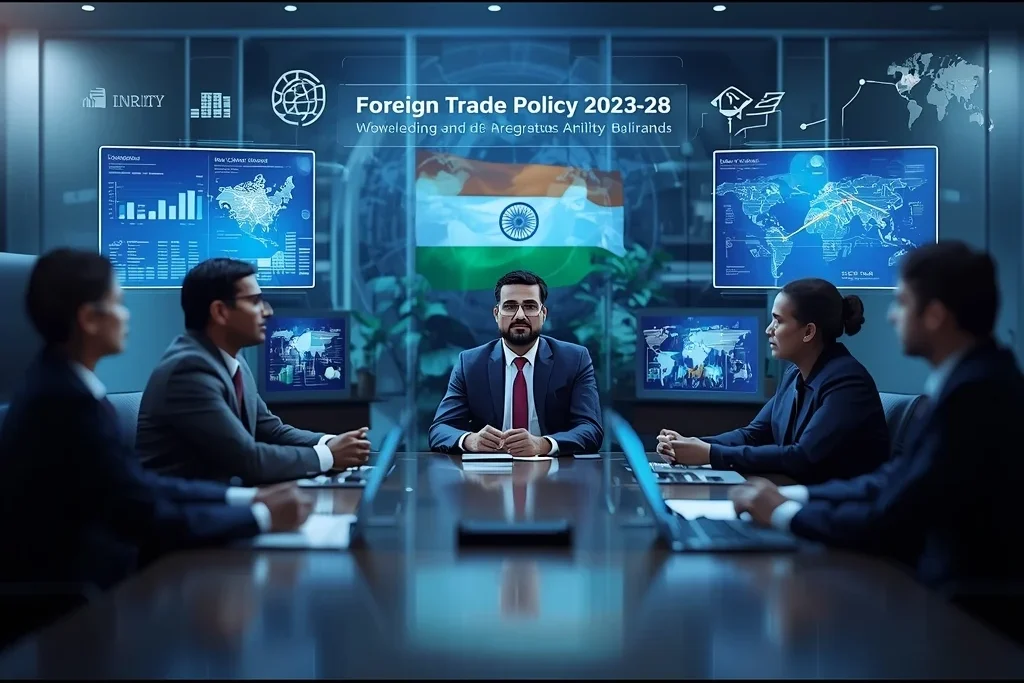
The Trade Policy of India and the Foreign Trade Policy 2023–28 are intently linked with India’s foreign direct investment (FDI) framework.
A solid alternate coverage boosts investor self assurance, imparting clarity on tariffs, responsibilities, and alternate-associated incentives. FDI inflows have gradually elevated due to India’s liberalized alternate and investment surroundings.
Buyers searching for predictable Export and Import Regulations and transparent Government Trade Reforms. The government’s current measures—like the advent of unmarried-window clearances, rationalized tariffs, and improved logistics infrastructure—have made India one of the top international funding destinations.
The alignment of Trade Policy of India with FDI objectives has ended in robust growth throughout production, offerings, and technology sectors.
What are India’s Main Trade Agreements?
India actively participates in numerous International Trade Agreements that facilitate smoother alternate of products and offerings.
Those agreements are key units of the Trade Policy of India, assisting reduce trade obstacles and promote economic cooperation.
India’s trade agreements may be labeled as:
- Bilateral Agreements – signed with person nations to encourage mutual change (e.g., India–UAE CEPA).
- Nearby Agreements – with agencies like ASEAN and SAARC to boost regional integration.
- Multilateral Engagements – via agencies including the World Trade Organization (WTO), where India advocates for equitable exchange policies.
Via these agreements, India secures favorable get entry to to international markets, at the same time as also protecting domestic industries through negotiated safeguards.
The Foreign Trade Policy 2023–28 emphasizes lively participation in such agreements to enlarge export capacity and improve alternate balances.
What are the Challenges in India’s Trade Policy?
In spite of terrific development, the Trade Policy of India faces several demanding situations. Global trade dynamics are evolving unexpectedly, and India should constantly adapt to remain competitive.
Key challenges include:
- Global protectionism: growing exchange barriers in superior economies impact exports.
- Compliance complexity: in spite of advanced Export and Import Regulations, procedural delays nonetheless arise at ports and customs.
- Infrastructure gaps: logistics and delivery inefficiencies have an effect on competitiveness.
- Era adaptation: many small exporters lag in digital transformation.
- Alternate imbalances: heavy import dependence on power and electronics increases the deficit.
The Government Trade Reforms beneath the Foreign Trade Policy 2023–28 aim to tackle these troubles by using promoting virtual change infrastructure, encouraging home production, and improving coordination amongst ministries and change our bodies.
Over the years, these reforms are expected to simplify compliance and lower transaction prices for organizations.
How Does the WTO Influence India’s Trade Policy?
The World Trade Organisation (WTO) presents the global framework for exchange governance, and India’s guidelines are aligned with its regulations.
The Trade Policy of India operates inside this gadget, balancing countrywide priorities with global responsibilities.
India advocates for a fair and inclusive buying and selling machine that benefits growing countries.
It’s been a strong voice for meals protection, sustainable development, and equitable marketplace get right of entry to. The Foreign Trade Policy 2023–28 also integrates these principles by promoting exports that meet environmental and moral standards.
Thru active engagement in the WTO and different International Trade Agreements, India works to defend its policy area for improvement even as ensuring it remains compliant with worldwide trade disciplines. This method enhances India’s worldwide credibility and helps long-term economic resilience.
Government Trade Reforms and Future Outlook
The Indian authorities has delivered a chain of Government Trade Reforms to modernize exchange practices and align them with worldwide developments. Those reforms encompass the implementation of digital facts interchange structures, simplification of customs processes, and strengthening of alternate finance mechanisms.
The reforms intention to create a seamless and green trade surroundings. In addition they fortify Export and Import Regulations to make alternate more obvious and predictable.
Underneath the Foreign Trade Policy 2023–28, there’s an growing emphasis on sustainability, innovation, and nearby improvement. Export promoting at the district level is anticipated to empower small groups and reduce urban-centric alternate attention.
The destiny outlook for the Trade Policy of India is positive. With continuous improvements in logistics, extra digitalization, and new trade partnerships, India is poised to end up a international buying and selling powerhouse.
Collaboration among government, industry, and international companions can be essential to knowing this imaginative and prescient.
FAQ related to India’s trade policy
1. What are the 4 pillars of trade policy?
Export promotion, import regulation, trade facilitation, and international trade agreements.
2. What was the trade policy of India in 1991?
The 1991 policy focused on liberalization, deregulation, and opening India’s economy to global trade.
3. What does FTP mean in India?
FTP stands for Foreign Trade Policy, governing India’s export and import framework.
4. What is the rank of India’s economy?
India is the fifth-largest economy in the world by nominal GDP.
5. What is the oldest instrument of trade policy?
Tariffs are the oldest and most traditional instrument of trade policy.
6. Who is the No 1 exporter of India?
Reliance Industries Limited is India’s top exporter across multiple sectors.
Conclusion
The Trade Policy of India represents a dynamic and evolving framework that defines the nation’s global economic engagement. It is a reflection of India’s objectives—to be both self-reliant and globally included.
Through continuous modernization, strategic partnerships, and ahead-looking reforms, India has positioned itself as a vital player in worldwide commerce.
The Foreign Trade Policy 2023–28 builds upon this legacy by means of emphasizing flexibility, inclusivity, and sustainability. It addresses emerging demanding situations, complements Export and Import Regulations, strengthens International Trade Agreements, and introduces transformative Government Trade Reforms.
As India’s economic have an effect on maintains to grow, its Trade Policy of India will remain significant to riding innovation, attracting funding, and ensuring balanced increase across sectors.
The combination of sound strategy, robust reforms, and global engagement makes the Trade Policy of India now not only a report of regulation—but a roadmap for a wealthy, resilient, and globally aggressive destiny.
Further Readings:
- Environment Protection Reform Bill: Powering India’s Green Future
- ECI Rules for Regulation of Political Parties
- Supreme Court Order on Feeding Stray Dogs 2025
Thank you for the good writeup. It if truth be told was a amusement account it. Glance advanced to more delivered agreeable from you! By the way, how can we keep in touch?