Introduction
India’s democratic structure depends heavily on the accuracy, transparency and reliability of its voter registration system. In recent months, one process has taken centre stage in national discussions—the Election Commission of India SIR Process. This procedure, formally known as the Special Intensive Revision (SIR), is a large-scale initiative designed to verify, clean, and update voter rolls. Its purpose is to ensure that every eligible citizen is included and every ineligible or duplicate entry is removed.
However, what was meant to be an administrative exercise has now transformed into a major legal and political development. With growing concerns raised by citizens, civil groups, and political parties, the matter has reached a point where a significant Supreme Court Challenge is underway. The challenge is not merely about voter rolls—it is about the integrity of elections, the process of accountability, and the broader functioning of Indian democracy.
Understanding the Election Commission of India SIR Process
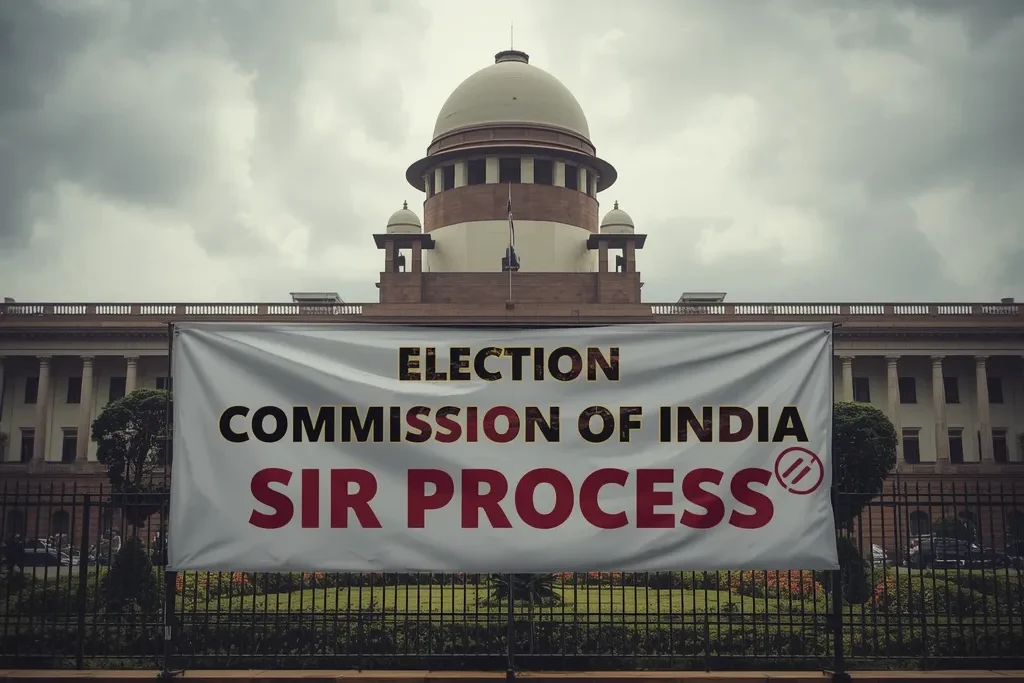
To understand the present controversy, one must begin with what the Election Commission of India SIR Process actually means. In simple terms, it is an exercise where officials conduct an intensified field-level verification to check whether names on the voter list are accurate. The process includes outreach visits, house-to-house surveys, document verification and cross-checking of demographic details.
The objective is to ensure:
- All eligible citizens aged 18 and above are included
- Duplicate entries are eliminated
- Deceased persons are removed
- Migrated voters’ entries are corrected or updated
- Newly eligible voters are added
This is not the first time the Election Commission has undertaken such activities. Voter list revisions occur annually. But what makes the latest revision significant is the scale of scrutiny, the political environment, and the legal challenges surrounding it.
Why the Special Intensive Revision (SIR) Became Necessary
The Special Intensive Revision (SIR) is usually implemented when the Election Commission feels certain regions require deeper inspection. Reasons include rapid urban migration, high population growth, complaints about discrepancies, or upcoming elections.
During this round of SIR, several states experienced:
- Large-scale migration from rural to urban zones
- Urban expansion resulting in new residential clusters
- Administrative boundary changes
- Complaints about inflated voter lists
- Reports of thousands of missing names in previous elections
These challenges made the Special Intensive Revision (SIR) essential. Public confidence in electoral rolls depends on periodic scrutiny, and the SIR is the Commission’s tool to make that happen effectively.
The Role of Voter List Verification and Its Importance
One of the central pillars of the current process is Voter List Verification. This method ensures that names listed in the electoral database are legitimate and belong to actual, eligible citizens. Verification usually involves:
- Door-to-door canvassing by Booth Level Officers
- Checking supporting documents like Aadhaar, age proof, or address proof
- Cross-matching voter details with national databases
- Allowing citizens to submit objections or modifications
- Public scrutiny through published draft rolls
For millions of young voters becoming adults each year, proper Voter List Verification ensures that their first electoral participation is secure and error-free. Likewise, older voters depend on accurate rolls to continue exercising their democratic rights.
Reliable verification is crucial because the voter list forms the foundation of:
- Parliamentary elections
- Assembly elections
- Local body elections
- Panchayat elections
Any flaw in the list can tilt the balance of political outcomes.
How the Electoral Roll Update Became a National Discussion
An Electoral Roll Update is normally a routine and non-controversial activity. But this time, the stakes have risen dramatically. With multiple states heading toward elections, concerns have emerged around:
- Sudden removal of legitimate voters
- Inclusion of duplicate entries
- Discrepancies in house-to-house verification
- Lack of public awareness
- Delays in grievance redressal
Citizens in some regions have reported that their names were missing despite participating in past elections. In others, complaints suggest that officials allegedly removed entries prematurely or without proper checks.
As the Electoral Roll Update progressed, social and political groups escalated their concerns, leading to formal legal petitions.
Why the Supreme Court Challenge Gained National Attention
The current Supreme Court Challenge revolves around allegations that the SIR process may not have been uniformly or fairly conducted across states. Petitioners argue that:
- Voter deletions were carried out without adequate notice
- Verification procedures lacked transparency
- Citizens were not given sufficient time to respond to objections
- Certain demographic groups were disproportionately affected
The Supreme Court has taken serious note of the matter and sought clarifications from the Election Commission.
The outcome of this Supreme Court Challenge could set a long-term precedent for how future voter list revisions must be carried out.
Historical Context: Past Issues with Voter Roll Accuracy

India has previously witnessed controversies over voter lists. During various state elections, large numbers of voters reported missing names, with some constituencies seeing thousands of deletions.
Examples include:
- Rapid migration leading to outdated addresses
- Multiple registrations for the same individual due to shifting cities
- Old entries that were never updated after deaths
- Clerical mistakes during enumeration
These patterns highlight why the Election Commission of India SIR Process is essential. Without periodic correction, errors multiply and undermine democracy.
Key Stages of the Special Intensive Revision (SIR)
The SIR consists of several well-defined phases:
- Drafting updated rolls
- Publishing draft lists for public scrutiny
- Accepting objections and claims
- Conducting Voter List Verification on the ground
- Updating entries based on findings
- Publishing final rolls
- Integrating the results into the national database
These steps ensure transparency, and each stage carries legal obligations. The integrity of these actions is also at the heart of the present Supreme Court Challenge.
Public Participation in the Electoral Roll Update
Citizens play a critical role in the success of any Electoral Roll Update. The process is not complete unless voters:
- Check their names
- Submit correction requests
- Provide supporting documents
- Report duplicate entries
- Ensure their household members are accurately listed
Digital tools like Voter Helpline App, NVSP portal, and state CEO websites make public participation easier. But awareness remains a challenge, especially in rural and semi-urban regions.
Challenges Faced During Voter List Verification
Although the verification process is crucial, several administrative and ground-level challenges impact its effectiveness:
- Inadequate manpower for door-to-door checks
- Inconsistent training of Booth Level Officers
- Difficulty locating migrants or tenants
- Lack of digital literacy among citizens
- Pressure to complete verification quickly
Despite these challenges, the Election Commission maintains that the Election Commission of India SIR Process is robust and essential to the democratic framework.
Concerns Raised in the Supreme Court Challenge
During the Supreme Court Challenge, various issues were highlighted:
- Whether adequate safeguards were applied uniformly
- Whether notices for deletions were properly served
- Whether political pressures influenced revisions
- Whether marginalised communities faced disproportionate deletions
The Court has asked the Commission to produce detailed records, including verification logs, public notices, and guidelines issued to field officials.
The Broader Impact of Electoral Roll Update on Democracy

A credible Electoral Roll Update is not merely administrative—it shapes the political environment. Accurate rolls ensure:
- Fair representation
- Inclusion of young voters
- Prevention of unlawful voting
- Trust in election outcomes
Inaccurate rolls can lead to disenfranchisement, legal disputes and political instability.
That is why the current debate on the Special Intensive Revision (SIR) has captured national attention.
How Technology Is Reshaping the Election Commission of India SIR Process
Digital advancements play a major role in strengthening the Election Commission of India SIR Process. Tools such as:
- Online application portals
- Aadhaar-linked verification
- GIS-based mapping of polling stations
- SMS and email notifications
These innovations have made the Voter List Verification process more accessible and accurate. However, concerns persist regarding data privacy and proper implementation.
Should the Special Intensive Revision (SIR) Be Reformed?
Many experts argue that the Special Intensive Revision (SIR) must be reformed to reduce future disputes. Suggested improvements include:
- Longer verification windows
- Increased manpower
- Greater public awareness campaigns
- Mandatory digital acknowledgements for every change
- Clearer timelines for objections and responses
Such reforms could reduce the likelihood of legal challenges similar to the present Supreme Court Challenge.
The Future of Electoral Roll Management in India
India’s population is dynamic, mobile and rapidly urbanising. Therefore, the Election Commission may need to adopt a continuous, real-time model of Electoral Roll Update instead of relying solely on periodic revisions.
Ideas under consideration include:
- Automatic registration at age 18
- Automatic deletion after confirmed death certification
- Regular Aadhaar-based address confirmation
- Unified national voter database
Each of these reforms has its own challenges, but they could make future Voter List Verification more accurate and reduce administrative burden.
FAQ of SIR process
1. SIR Election documents
Documents required for SIR Election include age proof, address proof, Aadhaar, and voter registration details.
2. Voter ID card check online
You can check your Voter ID status online via the NVSP portal or the official ECI website.
3. SIR Election full form
The full form of SIR Election is Special Intensive Revision Election, conducted for accurate voter list updates.
4. 11 documents for SIR Election
Commonly required documents include Aadhaar, Passport, PAN card, Driving License, Ration card, Utility bills, and other ID proofs.
Conclusion
The ongoing developments surrounding the Election Commission of India SIR Process are more than a temporary controversy—they represent a defining moment for India’s election system. As the Special Intensive Revision (SIR) continues and the Supreme Court Challenge unfolds, India stands at a crossroads.
Ensuring transparency, accuracy and fairness in the Electoral Roll Update is not only a legal requirement but a moral and democratic necessity. The future of Indian elections depends on a voter list that is inclusive, authentic and thoroughly verified.
Whether through reforms, technological innovation, or stronger legal oversight, the system will continue evolving. What remains constant is the importance of citizen participation and the commitment to a democracy where every vote counts.
Further Readings:
- National Cooperative Policy: India’s New Reform Vision
- UAPA Law in India: Key Impacts and Concerns
- New Labour Laws in India: Big Changes Coming!
**prodentim official website**
ProDentim is a distinctive oral-care formula that pairs targeted probiotics with plant-based ingredients to encourage strong teeth, comfortable gums, and reliably fresh breath