
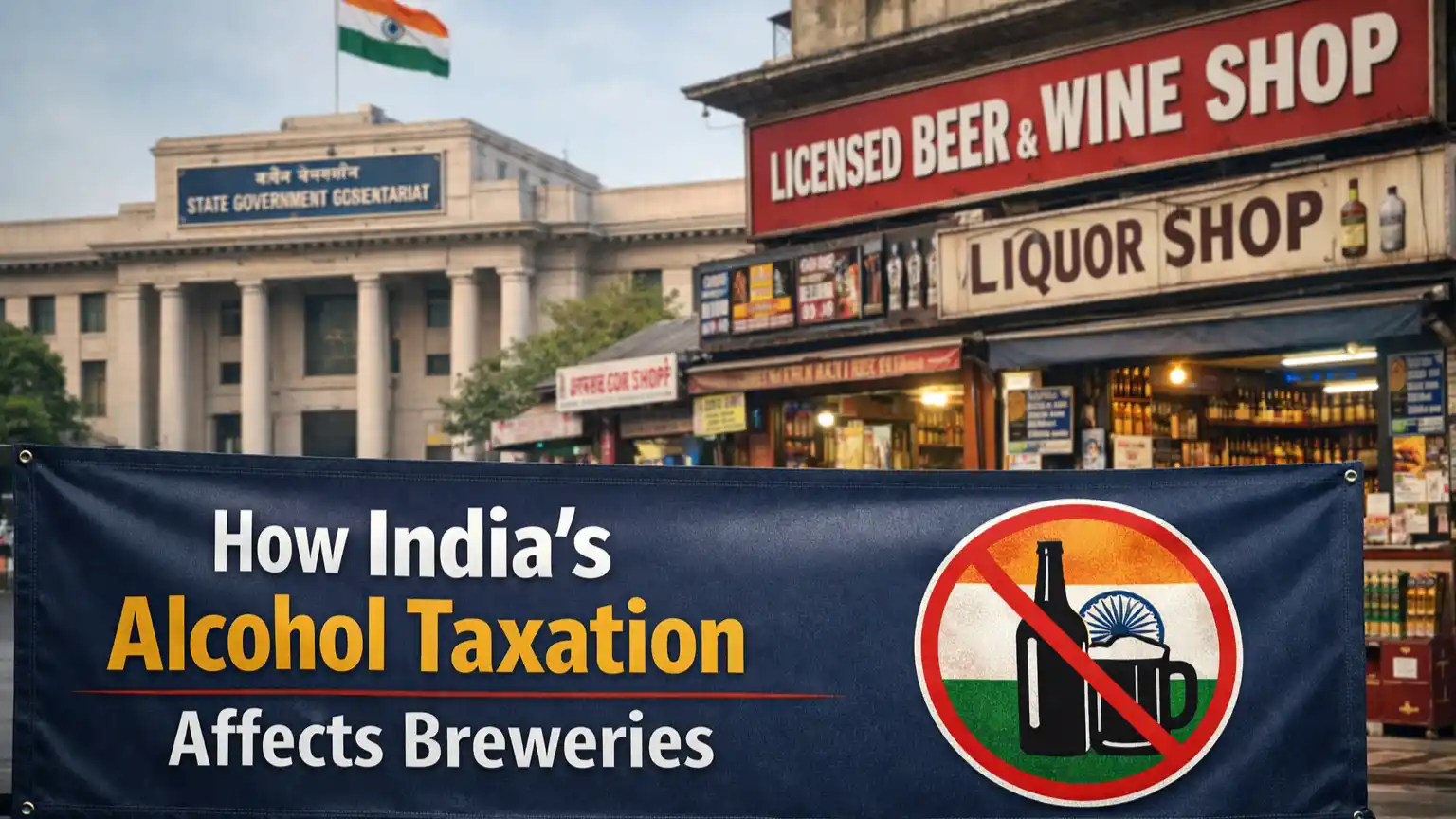
Introduction
India is often described as a high-growth beer market, driven by its large population, rising disposable incomes, and evolving consumption patterns. Yet, behind this promising demand story lies one of the world’s most complex regulatory systems.
For breweries, operating in India means navigating a labyrinth of stringent state laws, heavy taxation, licensing hurdles, and a convoluted controlled distribution system.
This article delves India alcohol laws for breweries explained, illustrating why brewers—particularly beer manufacturers and craft players—face persistent challenges despite the strong market potential.
From constitutional controls to excise duties, distribution monopolies, and compliance costs, India’s alcohol ecosystem is uniquely fragmented.
Why Alcohol Business Is Highly Regulated in India
To understand the challenges faced by alcohol producers, it’s crucial to why alcohol business is highly regulated in India. Alcohol has long been considered not just a commercial product, but also a social and public health issue.
This perspective has shaped constitutional and political decisions since independence. According to the Indian Constitution, alcohol falls under the State List, giving state governments complete authority over its production, sale, and taxation.
This framework allows states to formulate policies based on local political considerations. Some states, such as Gujarat and Bihar, enforce prohibition, while others rely heavily on alcohol revenue to fund welfare schemes.
For instance, in states like Karnataka, Maharashtra, and Tamil Nadu, excise revenue constitutes a significant portion of state finances. This dependence makes governments wary of liberalizing alcohol laws, resulting in stringent regulations and frequent policy interventions.
Constitutional Framework and Fragmented Alcohol Policy
Because alcohol is a state subject, there is no single national alcohol law. This division directly explains why beer manufacturing laws and taxes in India. A brewer operating nationwide must treat each state as a separate regulatory market.
For example, a beer brand approved for sale in Haryana cannot automatically be sold in Telangana or West Bengal. The label, bottle size, alcohol content, and even the brand name must undergo a fresh review to comply with local excise regulations.
| Aspect | Explanation |
|---|---|
| Constitutional status | Alcohol is a State subject under the Indian Constitution |
| Law-making power | Each state makes its own alcohol laws and excise rules |
| Central government role | Limited to industrial alcohol and interstate trade principles |
| Tax structure | Alcohol excluded from GST; states levy excise duty independently |
| Policy uniformity | No national alcohol law, leading to fragmented regulations |
| Impact on brewers | Different licenses, taxes, and compliance rules in every state |
This lack of uniformity increases costs, slows down distribution, and discourages smaller players from entering new markets.
Why Alcohol Taxation Is Different in Indian States
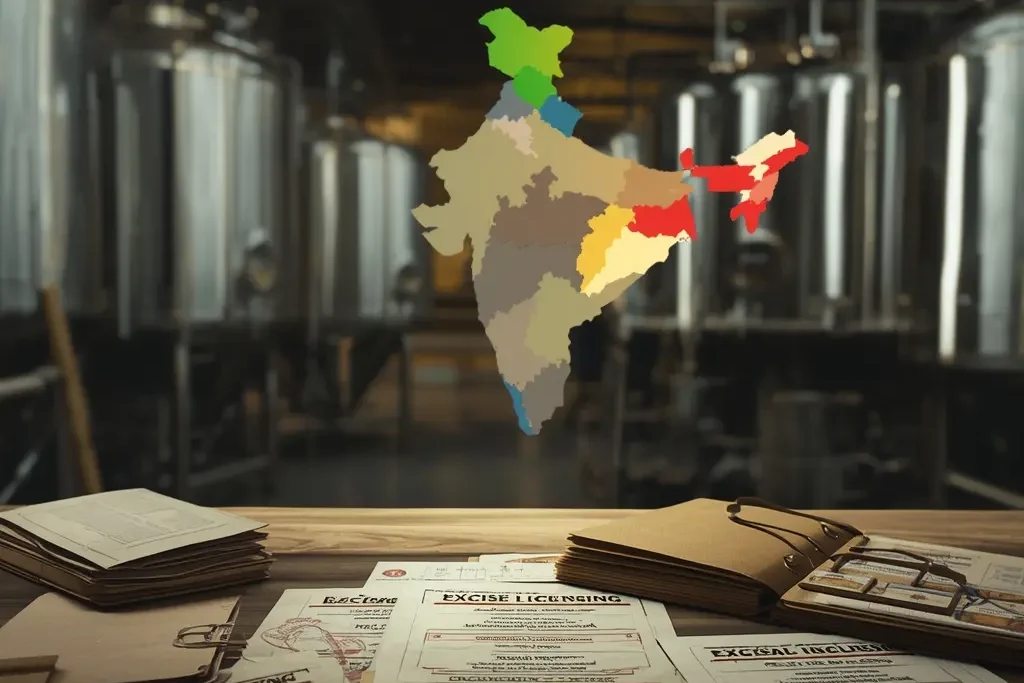
One of the most common questions in the industry is why alcohol taxation is different in Indian states. The answer lies in the exclusion of alcohol from the Goods and Services Tax (GST).
While GST created a unified indirect tax system for most goods, alcohol was kept outside its purview to protect state revenues.
Consequently, states levy excise duty, additional excise, special fees, and cess according to their own formulas. Some states tax beer based on its alcoholic content, some on volume, and others on the Maximum Retail Price (MRP).
For example:
- Delhi links excise duty to retail price slabs.
- Karnataka levies a tax per liter of beer based on its alcoholic strength.
- Tamil Nadu determines procurement prices through a government monopoly.
This explains why the same beer can be significantly cheaper in one state and more expensive in another, even before adding retail margins.
State-Wise Alcohol Licensing Rules in India
Licensing is one of the most challenging aspects of alcohol regulation. State-wise alcohol licensing rules in India, breweries must obtain numerous approvals before production and sales can begin.
Typically, brewers need to secure the following:
- A manufacturing license
- Brand and label registration (often subject to annual renewal)
- Distribution or wholesale permits
- Transportation and warehousing permits
For example, in Maharashtra, label registration fees are levied per SKU annually, making it difficult to experiment with new variants.
In Karnataka, while microbreweries are permitted, they face strict zoning regulations and limitations on off-site sales. These state-specific conditions make expanding operations across different regions slow and expensive.
Alcohol Distribution and Excise System in India
The Acohol distribution and excise system in India is a significant factor impacting the economics of alcoholic beverage companies. States adopt varying distribution models, each with different implications for manufacturers.
In states like Tamil Nadu and Kerala, government agencies handle both wholesale and retail sales. Manufacturers sell directly to state corporations at fixed prices, often experiencing delays in payment.
While this ensures a steady revenue stream for the government, it reduces manufacturers’ profit margins and limits brand visibility. Conversely, states like Haryana and Maharashtra allow private distribution but still maintain strict price controls.
Even in these markets, manufacturers cannot arbitrarily set prices or offer promotional discounts, further restricting flexibility.
“In India, beer is brewed nationally but regulated locally—one rulebook for every state.”
Impact of Excise Duty on Beer Prices in India
The Impact of excise duty on beer prices in India is substantial. In many states, taxes account for 40–60% of the final retail price of beer. This heavy tax burden reduces profit margins and influences consumer choices.
Surprisingly, despite having a lower alcohol content than spirits, beer is often priced similarly to hard liquor in high-tax states. This discourages consumers from opting for lower-alcohol beverages, undermining public health objectives.
When you buy beer in India, you are essentially paying a substantial “premium” to the state exchequer. Because alcohol is excluded from GST, the excise duty levied on beer in India is the primary determinant of its retail price.
- Government Monopolies: In states like Tamil Nadu or Karnataka, the government acts as the sole wholesaler. This alcohol distribution and excise system in India allows states to buy low from brewers and apply massive markups, squeezing manufacturer margins.
- The GST “dead end“: Brewers pay 18–28% GST on raw materials (bottles, malt, labels) but cannot claim input tax credit because beer is sold under the old excise/VAT system. This “trapped tax” increases production costs by 15–20%.
- The “specific versus ad valorem” divide: States levy taxes based on either volume (specific) or value (ad valorem). In high-tax states like Uttar Pradesh, the tax burden on the MRP can reach up to 69%.
- The Alcohol-by-Volume (ABV) paradox: Globally, beer is taxed less than spirits to encourage moderation. In India, regulatory hurdles for the brewing industry mean that beer is often taxed significantly more per unit of alcohol than hard whiskey.
- The “cess” culture: States frequently add last-minute surcharges to fund local projects—such as a “cow cess” or “social security cess”—leading to sudden, unjustified price increases for consumers.
| Factor | Impact on Beer Prices |
|---|---|
| Excise duty share | Forms 40–60% of final beer price in many states |
| State tax variation | Same beer priced differently across states |
| Pricing flexibility | Brewers have limited control over retail prices |
| Consumer affordability | Higher taxes make beer less affordable |
| Demand impact | High prices reduce consumption growth |
| Comparison with spirits | Beer often priced close to hard liquor |
For brewers, higher excise duties reduce demand elasticity, making it difficult to introduce premium, imported, or experimental products.
Challenges Faced by Beer Manufacturers in India
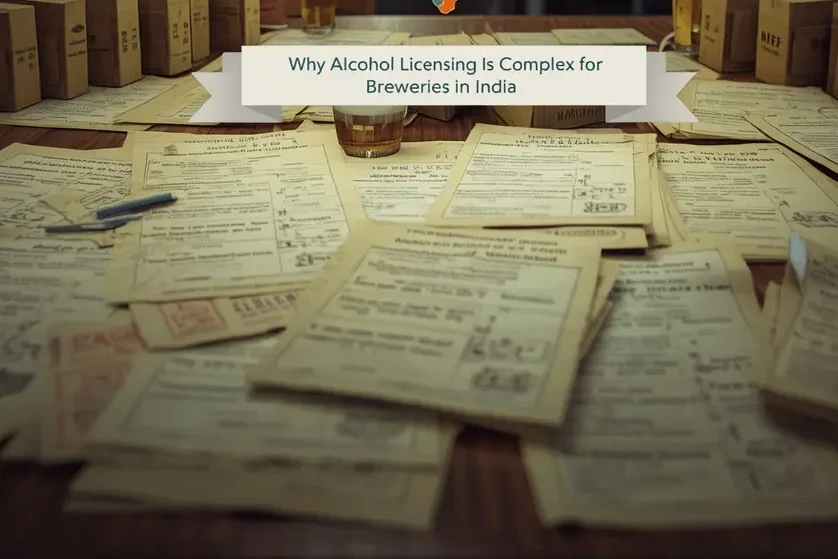
All these factors combined pose challenges faced by beer manufacturers in India. Compliance costs are high, regulatory hurdles persist, and working capital requirements are substantial due to advance tax payments and delayed receivables.
Sudden policy changes are another major concern. Abrupt increases in excise duty or changes in minimum retail prices can render a product unprofitable overnight. Large companies can absorb such shocks, but smaller players often cannot.
Regulatory Hurdles for Brewing Industry in India
Beyond taxation and licensing, regulatory hurdles for brewing industry in India also include outdated administrative systems. Many excise departments still rely on manual filing, physical inspections, and arbitrary approvals.
For instance, transport permits often have to be generated separately for each consignment, leading to increased paperwork and delays.
“For breweries, compliance costs often matter more than consumer demand.”
Any discrepancy in documentation can result in penalties or confiscation, even if no tax evasion has occurred. While some states have initiated digital reforms, the pace of adoption remains inconsistent.
How India’s Alcohol Policy Affects Craft Breweries
Stricter regulations impact mostly smaller players, which highlights how India’s alcohol policy affects craft breweries. Craft brewers generally incur the same licensing costs as larger companies, even though they produce much smaller quantities.
In cities like Bengaluru, Pune and Gurugram, microbreweries exist locally but face a lot of competition to sell beyond the city limits.
Limits on brewing, expensive compliance, and fewer taprooms allowed hinder scalability and investor appetite. Because of all this, many craft breweries stick to one niche, limiting the choices for new ideas and demanding consumers.
Why Reform Remains Politically Difficult
Despite industry advocacy, changes are occurring quite slowly. The state is not ready to give up power or take risks with the state.
This confirms why alcohol business is highly regulated in India even conducted in such a relaxed and saintly manner, even when the regulation does not keep pace with the ease of doing business.
Liquor revenues are very politically lucrative, and any reform is often viewed through the lens of elections, social policy, and fiscal sustainability.
The Way Forward for Breweries and Policymakers
Experts say that reform does not mean going out of control. Gradual steps like making label endorsements fair for all, digitalising licensing and making production prices common for low-alcohol products can help the country improve.
Selling liquor alcohol distribution and excise system in India backed by transparency and technology and by reducing and strengthening product pricing will benefit both governments and liquor manufacturers by reducing leakages and improving leakages.
“High excise on low-alcohol beverages defeats both public health and market efficiency“
Conclusion
India’s system, from state-wise alcohol licensing rules in India to the impact of Excise duty on beer prices in India, remains complex, fragmented and expensive.
The current “labyrinth” of state-wise liquor licensing rules in India treats every state border like an international border, making everything from restocking to pricing very difficult.
To move forward, the government needs to simplify the government duty on selling and manufacturing liquor in India. By changing the approach from “moral control” to “modern regulation”, states can ensure stable revenues without impacting the industry.
Ultimately, a more rational approach to the impact of government duty on beer prices in India will not only help the industry grow but also provide consumers with a fairer, more reliable market. Now is the time to eliminate excess paperwork and let the industry breathe.
FAQs
1. Why are alcohol laws different across Indian states?
Alcohol is a state subject, letting each state set its own taxes, licensing, pricing, and distribution rules for breweries independently.
2. Why is alcohol taxation different in Indian states?
Beer taxes differ because alcohol is excluded from GST, allowing states to impose excise duty, cess, and pricing controls locally.
3. What licenses do breweries need to operate in India?
Brewers need manufacturing licenses, annual label approvals, distribution permits, transport permissions, and must comply with frequent state-level regulatory changes nationwide.
4. How does excise duty affect beer prices in India?
Excise duty forms up to percent of beer prices, limiting demand, squeezing margins, and reducing affordability for consumers across states.
5. How do alcohol laws impact craft breweries in India?
Craft breweries face high license fees, limited self-distribution rights, local sales restrictions, and difficulty scaling operations beyond one city nationally.
6. Why is the alcohol business highly regulated in India?
India uses strict regulation to balance public health concerns with excise revenue needs, political sensitivities, and social control objectives nationwide.
Embedded some exte
**prodentim**
ProDentim is a distinctive oral-care formula that pairs targeted probiotics with plant-based ingredients to encourage strong teeth, comfortable gums, and reliably fresh breath
**men balance pro**
MEN Balance Pro is a high-quality dietary supplement developed with research-informed support to help men maintain healthy prostate function.
**herpafend**
Herpafend is a natural wellness formula developed for individuals experiencing symptoms related to the herpes simplex virus. It is designed to help reduce the intensity and frequency of flare-ups while supporting the bodys immune defenses.
**aquasculpt**
aquasculpt is a premium metabolism-support supplement thoughtfully developed to help promote efficient fat utilization and steadier daily energy.
**mounja boost**
MounjaBoost is a next-generation, plant-based supplement created to support metabolic activity, encourage natural fat utilization, and elevate daily energywithout extreme dieting or exhausting workout routines.