

Introduction
Education is the foundation of a strong and powerful society, and every child deserves equal access to get best education.
In our India, this aspect is supported by a powerful indian law which ensures that no child is left behind due to any kind financial or social reason

This article provides a clear Right to Education Act Explained, which helping students and parents to understand its purpose, rules, and impact on them.
The Right to Education Act 2009 India confirms Free and compulsory education India for each children within the RTE eligibility age limit.
By exploring the RTE Act key features, this detailed guide will help you understand how the law works and why it is important for you to build a bright future.
“Education is the most powerful weapon which you can use to change the world.” – Nelson Mandela
What is the Right to Education Act?
The Right to Education Act 2009 India is a landmark legislation that shows education as a fundamental right for your children.
It was passed by the Parliament of India in 2009 and came into action on April 1, 2010. Thus act ensures that children receive elementary education without facing any kind of discrimination or financial burden.
Under this law, the government is highly responsible for providing schooling facilities and ensuring that our every child has access to get free quality education.
The purpose of the Right to Education Act Explained is to solve your quires and to provide best education acknowledgement for You Child.
Main Objectives of the RTE Act in India
The main objectives behind the Right to Education Act 2009 India include:
- Ensuring universal access to education
- Promoting equality and inclusion
- Reducing dropout rates
- Improving the quality of schooling
- Strengthening the foundation of Free and compulsory education India
These goals mainly focus on building a more educated and empowered society where every child has the opportunity to succeed in their life.
RTE Eligibility Age Limit Criteria
One of the most important aspects of the law is the RTE eligibility age limit. According to the act:
- Children between the ages of 6 to 14 years are eligible
- Education for this age group is completely free
- It is compulsory for children to attend school
| Criteria | Details |
|---|---|
| Minimum Age | 6 Years |
| Maximum Age | 14 Years |
| Education Type | Free and Compulsory |
| Applicable Classes | Class 1 to Class 8 |
| Admission Rule | No Entrance Test Required |
| Late Admission | Allowed as per age |
| Applicable Schools | Government & Eligible Private Schools |
The RTE eligibility age limit ensures that your children receive education during their formative years, which is crucial for their overall development.
You can also Check: New Education Policy (NEP) 2026
Key Features of the RTE Act
The Key features are designed to make our indian education system inclusive and effective. Some of the most important keyword features are given below: 👇
1. Free Education
Under this law, children are entitled to free get education. This means that no child has to pay school fees or other expenses that might prevent them from accessing education.
2. Compulsory Education
The government ensures that your child must enrolled in school and completes their elementary education. This is a important part of the RTE Act.
3. No Discrimination
Schools are not allowed to discriminate or treat unequal to students on the basis of their caste, colour, religion, sex, or economic status.
*Organisation which Protect Children Rights— NCPCR
4. 25% Reservation in Private Schools
Private schools must reserve 25% of seats in their school for children who lay down under economically weaker sections.
5. No Capitation Fee
Any Schools cannot charge donations or capitation fees for admission of Children.
6. Qualified Teachers
Teachers must match specific qualifications and training requirements to ensure quality education for the students in the school.
7. Infrastructure Requirements
Schools must have proper facilities or equipments such as classrooms, toilets, clean drinking water, and playgrounds.
These RTE Act key features ensure that education is accessible, affordable, and of good quality.
Importance of Free and Compulsory Education in India
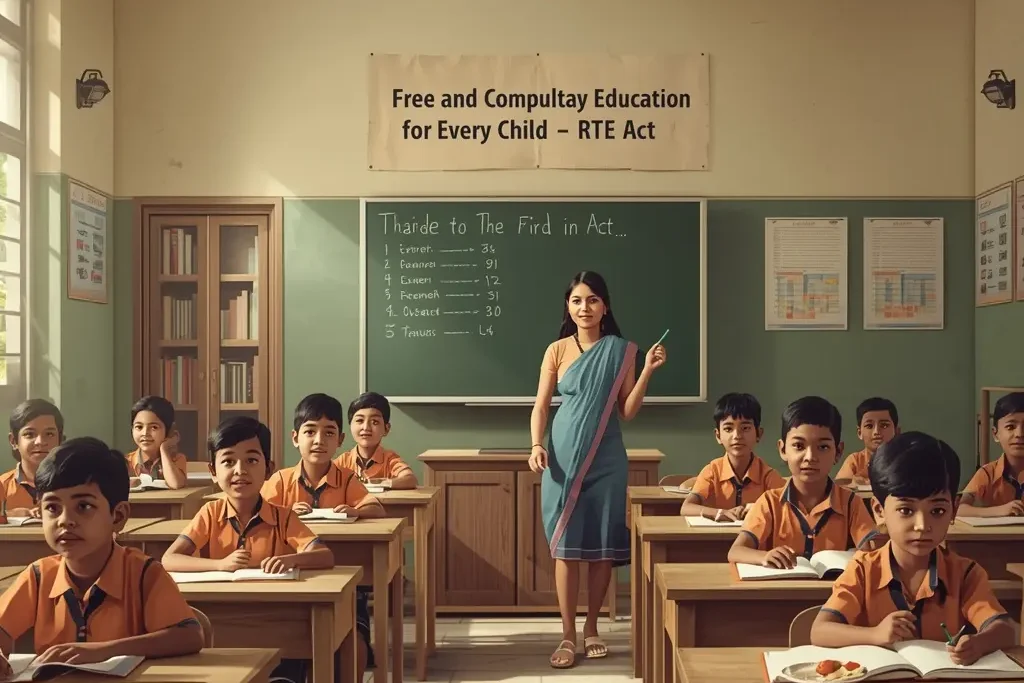
The concept of Free and compulsory education is essential for national growth and development of Country’s Youth. Education helps you to gain knowledge, develop skills, and improve your quality of life.
These are the reasons behind the importance of free and compulsory education for Every Children:
- Ensures equal learning opportunities for all children, regardless of background
- Helps reduce poverty by improving future earning potential
- Increases literacy rate across rural and urban areas
- Promotes gender equality by encouraging girls’ education
- Reduces child labor by sending children to school
- Builds a skilled and knowledgeable workforce
- Strengthens democracy through informed citizens
- Improves social awareness and responsibility
- Encourages personal growth and confidence in children
- Supports national development and economic growth
Admission Process which followed Under RTE
The Right to Education Act 2009 India simplifies the admission process for children. Some key rules include:
- No entrance tests for admission
- No donation or extra charges
- Basic documents are sufficient
- Children can be admitted even if they missed earlier schooling
These provisions make it easier for parents to enroll their children under Free and compulsory education India.
Responsibilities of the Government
The government plays a crucial role in implementing the Right to Education Act Explained. Its responsibilities include:
- Establishing schools in all areas
- Recruiting trained teachers
- Providing financial support
- Monitoring school performance
- Ensuring compliance with the RTE Act key features
By fulfilling these responsibilities, the government ensures that every child benefits from the law.
Responsibilities of Schools and Teachers
Schools and teachers are also responsible for implementing the Right to Education Act 2009 India effectively.
Schools Must:
- Provide free education to eligible children
- Follow reservation policies
- Maintain infrastructure standards
Teachers Must:
- Attend school regularly
- Complete the syllabus on time
- Focus on student learning and development
These roles are essential for achieving the goals of Free and compulsory education India.
Benefits of the RTE Act
The Right to Education Act Explained provides numerous benefits:
- Equal Access to Education: Ensures that every child, regardless of caste, gender, or financial status, gets an equal opportunity to study and grow in a supportive environment.
- Free Schooling: Eliminates financial barriers by providing free education, books, and basic facilities to children from economically weaker sections.
- Reduced Dropout Rates: Encourages continuous schooling, helping children complete their elementary education without interruptions.
- Social Equality: Promotes inclusion by bringing children from different backgrounds together in the same classrooms.
- Better Future Opportunities: Education improves career chances, helping children build a stable and successful life.
- Child Labor Reduction: Keeps children in schools instead of workplaces, protecting their rights and childhood.
- Improved Literacy Rate: Contributes to increasing literacy levels across the country, especially in rural areas.
The RTE Act key features ensure that children receive education without facing financial or social challenges.
Check Now— No.1 government Schemes for Startups
Challenges which may face during Implementation
Despite its advantages, the Right to Education Act 2009 India faces several challenges:
- Lack of awareness in rural areas
- Poor infrastructure in some schools
- Shortage of qualified teachers
- Quality of education concerns
| Challenge | Description |
|---|---|
| Lack of Awareness | Parents unaware of RTE benefits |
| Poor Infrastructure | Basic facilities missing in some schools |
| Teacher Shortage | Not enough trained teachers |
| Quality Issues | Low focus on learning outcomes |
| Weak Implementation | Rules not properly followed |
Addressing these challenges is important to fully realize the vision of Free and compulsory education India.
Role of Your Parents and Society
Parents and society play a main role in the success of the Right to Education Act Explained. They can:
- Encourage children to attend school regularly
- Spread awareness about the RTE eligibility age limit
- Monitor school facilities and teaching quality
- Support government initiatives
Active participation from society helps strengthen the impact of the law.
Recent Developments in RTE
Over the years, the government has make some improvements to enhance the effectiveness of the Right to Education Act 2009 India.
These are the following things including:
- Digital learning initiatives
- Better teacher training programs
- Improved monitoring systems
- Focus on learning outcomes
These developments ensure that the RTE Act key features remain relevant in modern education.
Situation: Before RTE Act vs After RTE Act
| Before RTE Act (Before 2009) | After RTE Act (After 2009) |
|---|---|
| Not a fundamental right | Became a fundamental right (6–14 years) |
| Limited access, especially in rural areas | Improved access for all children |
| Many couldn’t afford education | Free education provided |
| High dropout rates | Reduced significantly |
| Less focus on girls’ education | Equal opportunities for girls |
| Child labor was common | Reduced due to schooling |
| Poor school facilities | Basic facilities made mandatory |
| Untrained teachers | Focus on qualified teachers |
Bonus Link: New UGC rules 2026
Why the RTE Act is Important in 2026
In this fast evolving world, education is more important than ever. The Right to Education Act ensures that Your child doesn’t left behind due to any financial or social reason .
The act continues to promote Free and compulsory education India, helping your children to build a strong foundation for their future.
It also supports national development by creating a skilled and educated workforce for our country.
Conclusion
The Right to Education Act Explained clearly shows how important education is for you and for national growth.
The Right to Education Act 2009 India has played a crucial role in improving access to schooling and reducing inequality in education Sector.
By understanding the RTE eligibility age limit, following the RTE ‘s Key features, and supporting Free and compulsory education in India, we can ensure that every child gets the opportunity to learn and succeed.
Keep in Mind that Education is not just a right—it is the key to a brighter and better future for You.
“The function of education is to teach one to think intensively and to think critically.” – Martin Luther King Jr.