
Introduction

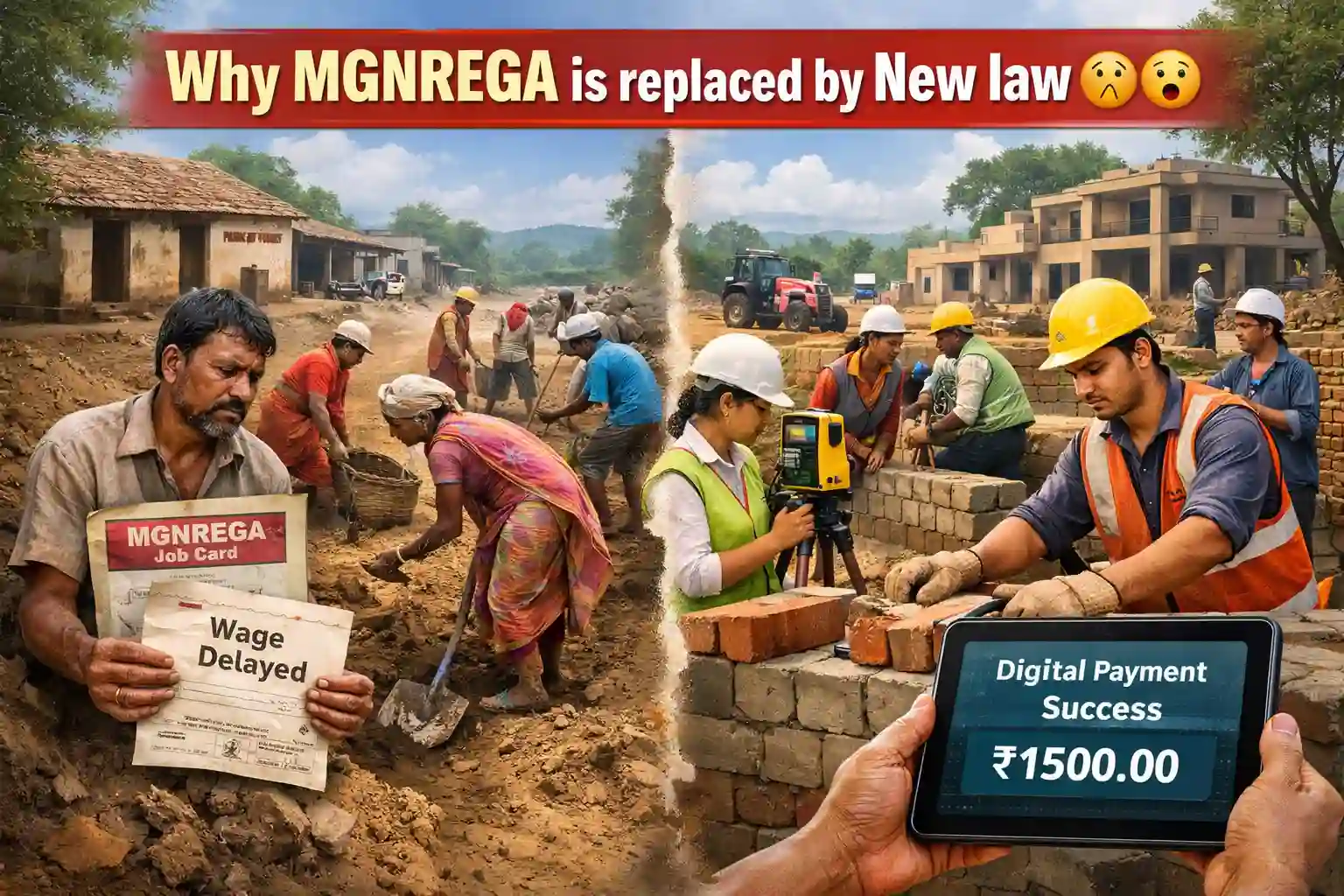
Rural employment has always been one of the most crucial and governmentally significant sectors in India. With approximately 65% of India’s population still residing in villages, employment security remains central to poverty reduction, social harmony, and essential development and I am here to tell How Rural employment law replacing MGNREGA?
Since agriculture alone can no longer sustain the entire rural workforce, public employment programs have played a vital role in providing income support. The Mahatma Gandhi National Rural Employment Guarantee Act (MGNREGA), enacted in 2005, was a landmark step in this direction.
It legally guaranteed 100 days of employment to rural households and has become one of the world’s largest public works programs. Over the years, it has supported millions of families during times of drought, agricultural distress, and national crises such as the COVID-19 pandemic.
However, after nearly two decades of implementation, the shortcomings of MGNREGA gradually became apparent. Persistent delays in wage payments, fewer workdays, limited opportunities for skill development, and rising aspirations in rural areas exposed its inherent weaknesses.
Today, rural India is younger, more educated, and more connected than ever before. The demand is no longer just for daily wages, but for stable employment. This changing reality has led to the introduction of the Rural Employment Law replacing MGNREGA which provides a streamlined framework for modernizing rural employment regulations.
The Rural Employment Law replacing MGNREGA 2025, signals a shift away from a purely welfare-oriented approach towards development-oriented employment, aligned with long-term economic aspirations.
What Is the New Rural Employment Law?
The new law replacing MGNREGA India through a responsible rural employment law that expands the concept of employment guarantee beyond unskilled manual labor.While it retains the legal entitlement to work, it redefines the nature, scope, and purpose of rural employment.
Simply put, the Rural Employment Law explained means that rural families are entitled not only to wages but also to meaningful work that contributes to their income enhancement, skill development, and overall well-being.
Under the new law, employment is linked to sustainable livelihoods, infrastructure development, and environmental sustainability.
Core Objectives of the Law
- Increase guaranteed workdays to improve wage security
- Create better and more job opportunities
- Ensure timely wage payments through digital governance
- Build sustainable and progressive rural infrastructure
- Strengthen planning through Panchayati Raj institutions
The new rural job scheme law views rural employment not merely as a direct welfare expenditure but as an investment in human capital and local infrastructure.
This shift reflects a people-centric approach aimed at transforming rural areas into engines of holistic development.
Why MGNREGA Is Being Replaced
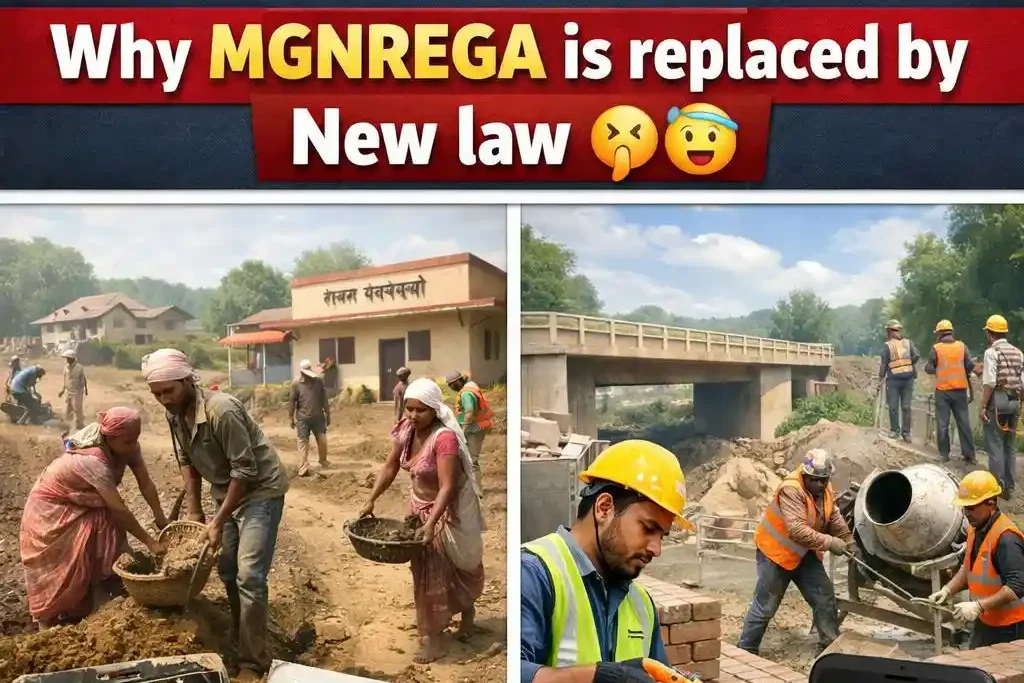
MGNREGA played a transformative role in its initial years, but its impact diminished over time due to several structural challenges.
Wage Delays and Trust Deficit
One of the most common complaints under MGNREGA was the delay in wage payments. Workers often had to wait for weeks or even months to receive their wages, forcing them to borrow money or seek work elsewhere. This led to a decline in confidence in the program and reduced participation.
Limited Nature of Work
MGNREGA primarily focused on unskilled manual labor, such as earthwork, excavation, and basic construction. While these jobs provided immediate income, they offered very few opportunities for skill development or long-term income growth.
Rising Rural Aspirations
In the last two years, there has been a significant increase in literacy levels in rural areas. Many young people in villages now aspire to skilled, decent, and respectable employment. The existing structure of MGNREGA has failed to meet these aspirations.
Continued Migration
Despite the job guarantee, work continued in urban areas due to fear. Fewer working days and stagnant wages meant that MGNREGA alone could not guarantee income security throughout the year.
| There are following main Reasons |
|---|
| Wage delays and limited workdays |
| Mostly unskilled, short-term jobs |
| Weak income and skill growth |
| Need for modern, livelihood-focused rural jobs |
The MGNREGA replaced by new employment law indicates that the government recognizes the need to transform rural employment schemes from merely acting as a safety net to focusing on productivity, skills, and sustainable livelihoods.
“Stronger rural jobs build a stronger India.”
Key Features of the Rural Employment Law Replacing MGNREGA
| Key Feature | Details |
|---|---|
| More employment days | Higher guaranteed workdays than MGNREGA |
| Skill-based jobs | Focus on skilled and semi-skilled work |
| Faster wage payments | Direct digital payments to workers |
| Durable assets | Creation of long-term rural infrastructure |
| Digital monitoring | Transparent tracking and accountability |
Increased Guaranteed Employment Days
A major change introduced by the rural employment law that replaced MGNREGA is the increase in the number of guaranteed employment days beyond the previous limit of 100 days. This provision is particularly crucial for regions where agriculture is dependent on seasonal rainfall.
More employment days provide a more stable income, reduce reliance on informal loans, and allow families to plan for expenses such as education, healthcare, and housing. This also strengthens rural demand, thereby supporting local markets.
Skill-Based and Livelihood-Focused Work
One of the biggest changes in the new law is the shift towards skill-based work. Workers can now participate in activities related to agriculture, water management, renewable energy, rural offices, food processing, and allied sectors.
This approach provides workers with opportunities to develop transferable skills, increasing their employability outside the scheme. Over time, this could reduce long-term dependence on government employment and promote entrepreneurship.
Faster Wage Payments and Digital Systems
In the previous system, delays in wage payments were a persistent problem. The Rural Employment Law explained a robust digital attendance system, automatic fund release, and real-time monitoring.
The Direct Benefit Transfer system ensures that wages are credited directly to the workers’ bank accounts, bringing transparency and accountability. Faster payments build trust and encourage greater participation.
“Employment with dignity, skills, and security.”
Focus on Durable Rural Infrastructure
The Rural Employment Law benefits India by prioritizing the creation of durable and productive assets. These include irrigation systems, water harvesting structures, village roads, storage facilities, sanitation infrastructure, and community assets.
Such infrastructure supports agriculture, enhances rural productivity, and provides resilience against climate change and natural disasters.
Difference Between MGNREGA and the New Rural Employment Law

The rural employment law that replaces MGNREGA is fundamentally different from its predecessor, both in its vision and implementation. MGNREGA primarily focused on providing short-term wage employment as a means of poverty reduction.
The new framework links employment to development outcomes, skill development, and economic productivity.
Key Differences
- Days of more guaranteed employment
- Inclusion of good and very good work
- Faster and more accurate wage payments
- Stronger digital monitoring and accountability
- Greater emphasis on asset quality and long-term impact
The new rural job scheme law reflects a shift towards rural development dependent on well-targeted employment-led growth.
Eligibility Criteria Under the New Law
The rural employment law, which will replace MGNREGA in 2025, remains committed to providing employment opportunities and ensuring inclusivity for all.
Rural families interested in working can register through their Gram Panchayats or designated authorities. Women, Scheduled Castes, Scheduled Tribes, migrant workers, persons with disabilities, and economically weaker families are given priority.
| Eligibility Criteria | Details |
|---|---|
| Residence | Must be a rural household |
| Age | Adult members (18 years and above) |
| Willingness to work | Ready to perform assigned work |
| Priority groups | Women, SC/ST, vulnerable households |
| Registration | Job card or official registration required |
Simplified registration and verification processes aim to prevent exclusion and ensure accountability. The Rural Employment Law explained principle of universal access while strengthening transparency and impartiality.
How the New Law Impacts Rural Workers
The Rural Employment Law benefits India by directly improving the quality of life for rural workers.
Income Stability
Expanded employment days and timely wages provide predictable income, reducing financial stress and vulnerability.
Women’s Empowerment
Women benefit through increased participation, equal wages, safer working conditions, and opportunities for skill development closer to home.
Reduced Migration
With stable local employment, distress migration to cities is expected to decline, strengthening rural families and communities.
Impact on Rural Economy and Development
The rural employment law is expected to boost rural economies by increasing purchasing power and improving infrastructure.
Better assets support agriculture, allied activities, and village development. Increased local demand benefits small traders, service providers, and self-help groups.
The decentralized nature of the scheme empowers local communities, while the new rural employment law links rural employment to national benefits such as independence, sustainability, and future growth.
Challenges and Criticism of the New Rural Employment Law
Despite its promise, the Rural Employment Law replacing MGNREGA faces challenges.
Funding Concerns
Expanded employment days and skill-based work require higher and sustained funding, raising fiscal concerns.
Implementation Capacity
State and local capacity varies widely, affecting quality and consistency of implementation.
Digital Divide
Digital systems may exclude workers lacking access or literacy if safeguards are not in place.
Addressing these issues is essential for the success of the MGNREGA replaced by new employment law.
Government Safeguards and Monitoring Mechanisms
The proposed Rural Employment Law explained safeguards such as social audits, a grievance redressal system, and a real-time dashboard.
These mechanisms aim to prevent misuse of funds, ensure timely payments, and build trust through transparency, thereby fostering confidence in the new law replacing MGNREGA India.
Expert Opinions and Policy Perspective
Economists and policy analysts largely view the rural employment law replacing MGNREGA in 2025 as a crucial transformation of rural employment policy.
Experts emphasize its potential to link poverty reduction with productivity and income generation. However, they stress that its success hinges on funding certainty, strong government commitment, and cooperative federalism.
Future of Rural Employment in India
The Rural Employment Law benefits India by laying the foundation for future rural jobs in green energy, agro-processing, digital services, and rural entrepreneurship.
Integration with skill development missions and various development programs can transform rural employment from a safety net into a driver of economic growth.
“Jobs that create futures, not just wages.”
Conclusion
The Rural Employment Law replacing MGNREGA, represents a significant shift in India’s rural employment structure. By strengthening the guarantee of work, integrating skills development, and focusing on sustainable development, it addresses many of the shortcomings of the previous MGNREGA program.
If implemented effectively, the MGNREGA replaced by new employment law has the potential to empower rural communities, reduce inequality, and contribute to India’s long-term economic transformation.
Top 5 FAQs
1. What is the Rural Employment Law replacing MGNREGA?
It is a new law guaranteeing rural jobs with more workdays, skills, and faster wage payments.
2. Why was MGNREGA replaced by a new employment law?
MGNREGA had wage delays and limited scope; the new law focuses on skills and livelihoods.
3. How many employment days are guaranteed under the new law?
The law increases guaranteed workdays beyond MGNREGA’s 100-day limit.
4. Who is eligible under the Rural Employment Law?
All rural households with willing adult members, especially women and vulnerable groups, are eligible.
5. How does the new law benefit rural workers?
It ensures timely wages, skill development, income stability, and reduced distress migration.