

Introduction
The recently introduced law named Punjab anti-sacrilege law has become one of the most discussed legal and religious developments law in India in 2026.
The law, officially known as the Jaagat Jot Sri Guru Granth Sahib Satkar (Amendment) Act, 2026 which was introduced by the Punjab government to provide stricter punishment for acts of sacrilege against the Guru Granth Sahib.
However, while many people came tougher action against desecration, others raised concerns about its implementation and possible misuse.
The issue getting even more attention after an HT report on Punjab anti-sacrilege law which highlighted how devotees in Punjab started surrendering Gutka Sahibs and religious scriptures to gurdwaras due to fear of legal regulations or complications.
“Faith needs protection, but devotees also need trust.”
What Is the Punjab Anti-Sacrilege Law?
The new sacrilege law in Punjab was passed by the Punjab Assembly in April 2026.
This law provides strict punishment like life imprisonment and heavy fines, for intentional acts of sacrilege included the Guru Granth Sahib.
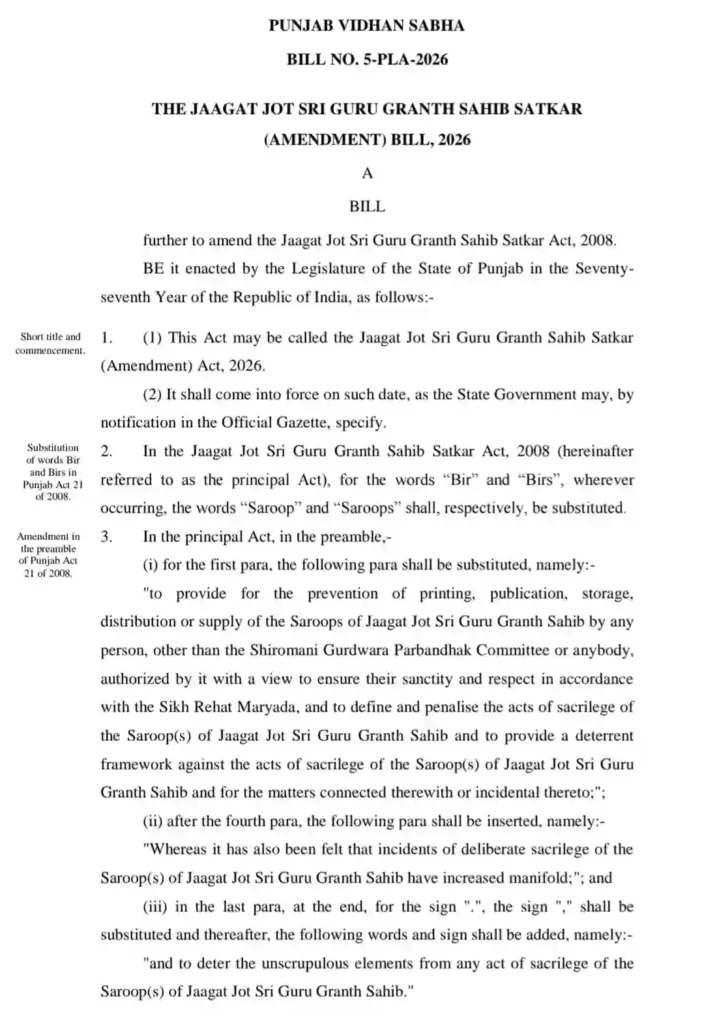
As per the government statement s, the purpose of the law is to protect religious sentiments and maintain communal harmony in Punjab.
The law includes punishments such as:
- Minimum imprisonment of 7 years
- Maximum punishment extending to life imprisonment (Protect Yourself)
- Fines ranging from ₹2 lakh to ₹25 lakh
- Strict provisions for conspiracy or organized sacrilege acts
This Punjab scripture law update was designed as a historic step by the Punjab government, especially after some years of public anger over past sacrilege incidents in the state of Punjab in INDIA.
Why Did Punjab Introduce This Law?
Punjab has witnessed several controversial sacrilege incidents over some past decade.
The 2015 Bargari sacrilege case is a major reason which created massive protests and political instability across the punjab state.
Spiritual organizations and Sikh or Punjabi groups repeatedly demanded stronger laws and faster justice for their State.
The state government saw that older laws were not strong enough to prevent such kind of incidents.
Therefore, the Punjab anti-sacrilege law was purposed to send a strict message against disrespect toward holy scriptures.
Chief Minister Bhagwant Mann described this law as a major next step toward protecting Sikh religious sentiments and religious fraternity.
The Punjab government even organized a “Shukrana Yatra” after the law was passed.
Why Are Devotees Worried of this Law?

Despite support for strict punishment against sacrilege, many Sikh scholars and devotees are worried about certain clauses in the legislation.
The biggest controversy is mainly related to records and management of scriptures which kept by devotees at home.
The HT report on Punjab anti-sacrilege law revealed that several families feared accidental damage or unintentional mistakes could lead to legal or constitutional trouble.
At the last, hundreds of Gutka Sahibs and religious books were reportedly surrendered to gurdwaras in some areas of Punjab.
This situation created emotional and religious anxiety among devotees because keeping scriptures at home has long been a part of Sikh religious practice which followed from their sapiens.
The problem is not about opposing punishment for deliberate sacrilege. Instead, people fear that ordinary devotees may face legal pressure even for accidental mistakes.
Holy Scriptures at Home Punjab: Why This Became a Major Debate
The issue of holy scriptures at home Punjab became the main focus of public debate after reports emerged that some devotees no longer felt comfortable keeping scriptures in their own homes.
For generations, Punjabi families have respectfully maintained Gutka Sahibs, pothis, and religious old text or script at home for daily prayers to waheguru.
However, after this new law came into action, uncertainty and fear reportedly increased among people.
For example:
| Situation | Earlier Practice | After New Law |
|---|---|---|
| Keeping Gutka Sahib at home | Common religious practice | Some families now hesitant |
| Accidental damage to scripture | Managed within religious customs | Fear of legal consequences |
| Role of gurdwaras | Religious guidance | Increased surrender of scriptures |
| Community responsibility | Based on trust and faith | Fear of legal scrutiny |
This comparison shows why the Punjab scripture law update has triggered both emotional and legal discussions across our Punjab State.
Akal Takht and SGPC’s Objections
The Akal Takht and Shiromani Gurdwara Parbandhak Committee (SGPC) strongly objected to certain provisions of this Punjab anti-sacrilege law.
Religious leaders such as Sant Samaj/Dera, etc. stated that Sikh institutions were not fully consulted before the legislation was passed.
One major objection which involved by the them is the proposal related to maintaining digital records and data of Guru Granth Sahib saroops.
Sikh religious leaders argued that religious matters should remain under their culture Panthic control rather than government monitoring.
The Akal Takht even gave the Punjab government a 15-day ultimatum to amend the controversial clauses.
According to Sikh scholars, while punishment for intentional sacrilege is important as well as laws should avoid creating fear among ordinary devotees.
“Religious laws must unite people, not create fear.”
Supporters who said Strict Punishment Is Necessary
Supporters of the Punjab anti-sacrilege law believe that strong laws are vey essential to stop repeated incidents of sacrilege in their Punjab.
They argue that:
- Religious sentiments deserve legal protection
- Strict punishment can discourage offenders
- Previous cases lacked strong legal action
- Public anger demanded tougher laws
Many people also feel that sacrilege cases often create communal tension and law-and-order issues among the spiritual sikhs.
Therefore, they support harsh punishment for anyone who intentionally disrespecting thier religious scriptures.
The Punjab government has repeatedly defended this Punjab anti-sacrilege law by saying that it reflects the emotions of the our Sikh community.
Critics Fear Misuse of the Law
Legal experts and scholars, however, fear the new sacrilege law in Punjab could be misused if proper safeguards are not added by the government.
Some concerns include:
- False complaints
- Personal rivalry cases
- Fear among granthis and sevadars
- Government interference in religious management
- Confusion over accidental versus intentional acts
A report by legal experts warned that this law may create an atmosphere where people stuck in suspicion rather than trust.
Critics also emphasized that these criminal laws involving religion require extremely careful before drafting because even small misunderstandings can trigger social unrest and instability in sikh’s religiou practices.
Difference Between Old and New Sacrilege Laws
Here is a table showing clear comparison between the earlier framework and the latest Punjab scripture law update:
| Earlier Law | New 2026 Amendment |
|---|---|
| Limited imprisonment | Up to life imprisonment |
| Lower penalties | Up to ₹25 lakh |
| Limited definition | Wider definition including digital acts |
| Minimal monitoring | Increased scrutiny concerns |
| Demand for stronger laws | Mixed response and controversy |
This comparison explains why the Punjab anti-sacrilege law has become such a politically and socially sensitive issue.
Real-Life Example From Punjab
One of the most appropriate examples came from Sunam in Sangrur district, where devotees reportedly deposited hundreds of Gutka Sahibs and religious books in gurdwaras due to fear after the law was coming in force.
This thing highlighted that how legal reforms can sometimes create unintended consequences at the ground level.
For many families, this was not simply about law. It became an emotional issue which connected to their daily religious life Practices.
Political Perspective Behind the Debate
The sacrilege issue has always hold political importance in Punjab politics.
Different political parties have used this issue during elections and public campaigns for various purpose.
The ruling Aam Aadmi Party which stands for AAP presented Punjab anti-sacrilege law as a major achievement of their government.
Opposition parties, however, questioned whether the government was using the issue politically before elections.
Some critics argued that unresolved old sacrilege cases should have been prioritised before introducing this kind of stricter laws.
Legal and Constitutional Questions which Arises
The new sacrilege law in Punjab has also triggered constitutional debates.
Legal experts have raised questions such as:
- Can religious management be monitored by the state?
- Are the punishments proportionate?
- Could the law affect freedom of religion?
- Is there enough protection against misuse?
Some questions are also raised in your Mind such as:
- Is it a government initiative which used by politicians to regulate religious practice of Sikhs?
- Is it Constitutional or not?
- How it negatively impact Religious Practice of Sikhs?
Some petitions and legal discussions have already started regarding these constitutional concerns.
Experts believe that courts may eventually examine whether these certain provisions balance religious protection with individual rights.
Prons & Cons of the New Sacrilege law
Pros:
- Protects holy scriptures and religious sentiments
- Strict punishment may reduce sacrilege incidents
- Helps maintain communal harmony
- Stronger legal action than previous laws
- Shows respect toward Sikh faith and traditions
Cons:
- Fear of misuse through false complaints
- Devotees worry about accidental mistakes
- Concerns over government involvement in religious matters
- Mixed reactions from Sikh organizations
- Fear among families keeping scriptures at home
Common FAQ of this Law
1. What is the Punjab anti-sacrilege law?
A new Punjab law introducing stricter punishment for sacrilege against holy scriptures and religious sentiments.
2. Why is the new sacrilege law in Punjab controversial?
Critics fear misuse, legal confusion, and increased fear among devotees keeping scriptures at home.
3. What punishment is included in the Punjab anti-sacrilege law?
The law includes imprisonment up to life sentence and fines reaching ₹25 lakh.
4. Why are devotees surrendering scriptures to gurdwaras?
Many families fear accidental damage may create legal problems under the new law.
5. What did the HT report on Punjab anti-sacrilege law reveal?
It highlighted growing concern among devotees and surrender of scriptures in several Punjab areas.
Public Sentiment in Punjab
Public opinion remains divided.
Many people support strict punishment against intentional sacrilege because religious sentiments are highly respected in their state.
On the other hand, many devotees want assurance that innocent people will not suffer because of unclear provisions of this Law.
This balance between protecting faith and avoiding fear is now the centre point of the entire debate around the Punjab anti-sacrilege law.
Conclusion
The Punjab anti-sacrilege law represented as one of the strictest religious protection laws which introduced in recent years.
While the government says this law is important to prevent sacrilege and maintain respect for the Guru Granth Sahib at the other side critics fear it may unintentionally create fear among ordinary devotees.
The recent HT report on Punjab anti-sacrilege law showing devotees surrendering scriptures which demonstrates that how sensitive this issue has become in Punjab.
The debate over holy scriptures at home Punjab is not just legal or political. It is deeply emotional, religious, and connected to Sikh identity and traditions which followed by their gurus .
As discussions continue between the government, Sikh institutions, legal experts, and among Us.
The future of this Punjab scripture law update may depend on whether authorities can create a balance between strict punishment law for deliberate sacrilege and protection for innocent devotees.
“Respect for scriptures and justice must go together.”
Further Posts: