

Introduction
India’s taxation system is a major transformation with the introduction of the New Income Tax Law 2026. These changes are not just about changing tax rates but about simplifying the entire tax structure of India.
For many years, taxpayers like you and me struggled with strict provisions, multiple deductions, and confusing things like assessment year and financial year.
Now, Indian government has introduced a modern, simplified system that focuses on clarity, transparency, and ease of compliance for everyone.
The New Tax Rules India 2026 Explained aim to make tax filing more easier for you without professional help.
These reforms, supported by the Budget 2026 Tax Reforms India which are expected to improve compliance and reduce disputes among public.
Understanding these changes is important for you because they directly impact your income, savings, and financial planning.
“Simple tax laws build stronger compliance.”
What is New Income Tax Law 2026?

The New Income Tax Law 2026 is based on the newly purposed Income Tax Act, 2025, (PDF)which replaces the old Income Tax Act of 1961.
This new law comes into effect from 1st April, 2026, and aims to simplify India’s tax system significantly.
One of the biggest changes in this new law is that reduction in complexity. Earlier, the law had more than 700 sections which making it difficult to understand for common people.
This New law reduces unnecessary provisions and uses simpler language so that taxpayers can easily interpret or involve in it.
Another major feature is the introduction of a single “tax year,” replacing the confusing system of financial year and assessment year. This change individually makes tax timelines easier to understand.
The Latest Income Tax Updates 2026 also show that the government is focusing on digital/online compliance. Tax filing, verification, and processing are becoming faster and more automated.
These Key Highlights are included in this Law
Tax Slab Changes
These are the following changes given below 👇:
- The Income Tax Slab 2026 India remains largely stable, ensuring there is no drastic increase in tax burden.
- The government has chosen stability to allow a smooth transition into the new tax system.
- Under the new regime, income up to ₹4 lakh is tax-free.
- Income above ₹4 lakh is taxed progressively based on different slabs.
- The rebate system ensures that individuals earning up to a certain limit may not have to pay any tax.
- This structure is especially beneficial for middle-class taxpayers.
Updates on Litigation Policy of 2026— Check Here
New Rules and Deductions
The New Tax Rules India 2026 Explained highlight a shift from multiple deductions to a simplified structure.
- The old tax regime still allows deductions like Section 80C and 80D.
- The new tax regime focuses on fewer deductions but offers lower tax rates.
- Salary components have been updated, with clearer taxation rules.
- Certain perks such as company-paid benefits and allowances may now be taxed more clearly.
- This may lead to an increase in taxable income in some cases.
- The Latest Income Tax Updates 2026 introduce improved clarity in income reporting.
- Stricter compliance requirements have been implemented to reduce tax evasion.
Major Updates
The Budget 2026 Tax Reforms India introduced several structural improvements.
- One major update is the simplification of tax laws and forms.
- New ITR forms are designed to reduce confusion and improve user experience.
- The government has tightened reporting requirements to ensure greater transparency.
- At the same time, procedures have been simplified to reduce the burden on honest taxpayers.
- Another significant change is the expansion of benefits like HRA exemptions to more cities.
- This provides additional financial relief to salaried individuals.
This is the Income Tax Slab 2026
To understand the Income Tax Slab 2026 India, let’s take a simple example.
Suppose a person earns ₹12 lakh annually. Under the new tax system, the income is divided into different slabs, and tax is applied step by step on him/her.
For the first ₹4 lakh, no tax is charged on him. The next portion is taxed at a lower rate, and the remaining income is taxed at slightly higher rates.
This progressive system ensures fairness, as higher earners pay more tax. According to the Latest Income Tax Updates 2026, this kind of structure is designed to balance revenue generation with taxpayer relief.
The key idea behind this New Income Tax Law 2026 is not to increase taxes but to make calculations simpler and more transparent for public.
Quick Comparison: Old vs New Tax Regime
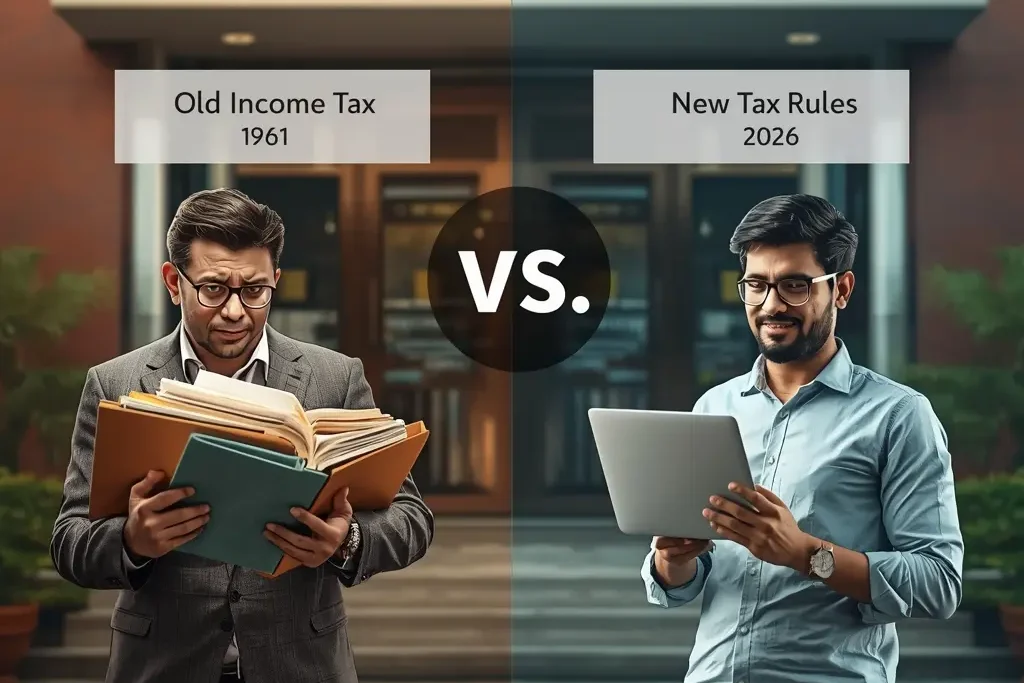
The New Tax Rules India 2026 Explained clearly show that both old and new tax regimes will continue to exist. Taxpayers can choose the option that suitable for them.
The old regime offers multiple deductions, which is beneficial for people who invest heavily in tax-saving things.
On the other hand, the new regime offers lower tax rates but fewer deduction which making more it simpler in comparison to Old system.
The Latest Income Tax Updates 2026 suggest that the new regime is now the default option for most taxpayers.
This indicates the government’s intention to gradually shift towards a digital or online simplified system.
Here is a simple comparison table to summarise above things:
| Old Tax Regime | New Tax Regime |
|---|---|
| Higher tax rates | Lower tax rates |
| Many deductions (80C, 80D, HRA, etc.) | Very limited deductions |
| High complexity | Simple structure |
| Complicated filing process | Easy filing process |
| Suitable for investors & tax planners | Suitable for salaried with fewer deductions |
| Not default option | Default option |
| More flexibility | Less flexibility |
From our practical perspective, individuals with fewer investments may get more benefit from the new regime, while those with higher deductions may still prefer the old system as the best option for them.
RTE Complete Details Here👈
Impact of New Tax law on Taxpayers
The New Income Tax Law 2026 affects different categories of taxpayers in different ways. These are the categories with details given 👇here:
- Salaried Individuals – The new tax law simplifies salary taxation and reduces calculation complexity, but fewer deductions may slightly increase taxable income for some employees.
- Business Owners – Businesses benefit from simplified compliance rules and reduced legal complications, making it easier to manage taxes and focus on growth.
- Self-Employed Professionals – Professionals like doctors, lawyers, and consultants get clearer tax rules, helping them file returns more accurately and efficiently.
- Freelancers and Gig Workers – The new system improves income reporting and makes tax filing easier, especially for those with multiple income sources.
- Small and Medium Enterprises (SMEs) – SMEs experience less compliance burden and better clarity in tax provisions, which supports smoother operations.
- Senior Citizens – Simplified procedures and stable tax slabs provide ease and predictability in tax planning.
- Non-Resident Indians (NRIs) – Improved reporting requirements and clearer tax rules ensure better transparency and compliance for global income.
The Budget 2026 Tax Reforms India mainly aim to create a fair and efficient system that benefits all types of taxpayers with making improvements in compliance.
Benefits and Drawbacks of this New Income Tax Law

Benefits
1. Simplification: Easier tax structure with clear rules
Example— Ramesh who is a salaried employee, earlier he got confused between Financial Year (FY) and Assessment Year (AY) while filing taxes. Under the new system, he only deals with a single “tax year.”
Impact— Now he can clearly understands deadlines and filing periods which reducing his mistakes and saving time.
2. Ease of Filing: Reduced paperwork and quicker return filing
Example— Priya, who works in a private company ,she used to depend on a CA every year. With simplified ITR forms, she now fills her return using pre-filled data on the portal.
Impact— She saves money on professional fees and files her tax return faster and independently.
3. Transparency: Better tracking and less scope for errors
Example— Amit, a freelancer, receives payments in multiple bank accounts. Now, all his transactions are automatically tracked and reflected in his tax profile.
Impact— Amit reports income accurately, avoids penalties, and maintains a clean financial record.
4. Faster Processing: Quicker refunds and automated systems
Example— Neha filed her return and earlier waited 2–3 months for a refund. With automated processing, she can now receives her refund within a few weeks.
Impact— Faster refunds improve her cash flow and financial planning.
5. User-Friendly System: Improved ITR forms and digital experience
Example— Suresh was a small shop owner who had limited technical knowledge. So, he uses the updated tax portal and follow our guides which help him step-by-step while filing returns.
Impact— He can confidently files taxes without confusion and also reducing dependency on others and avoiding errors.
Drawbacks or Challenges
These are some drawbacks of New Tax Law:
- Limited Deductions – Fewer tax-saving options in the new regime
- Not Ideal for Investors – Less benefit for those using deductions heavily
- Transition Challenges – Initial confusion for many taxpayers
- Higher Taxable Income – Some perks and allowances now taxable
- Adjustment Required – Need to understand and adapt to new rules
Important FAQs of New Regime Tax Laws
1. What tax changes are expected in 2026?
New Income Tax Act 2025, tax year concept, simplified filing, revised TDS/TCS rules introduced.
2. What is the tax slab for 2026?
No major change; income up to ₹4 lakh tax-free, progressive rates continue.
3. What is new in Budget 2026 for salaried employees?
No slab change; improved HRA benefits, simplified filing, updated compliance rules introduced.
4. New Income-tax Rules, 2026 PDF
Official rules notified by CBDT, effective from 1 April 2026.
PDF Download 👈
5. New income tax rules on cash transactions
Stricter reporting, mandatory PAN linking, and monitoring of high-value cash transactions introduced
Conclusion
The New Income Tax Law 2026 taken a important step toward a simpler and more transparent taxation system in India.
While the Income Tax Slab 2026 India remains largely stable in which real change lies in the design and proposal of taxation.
Through the New Tax Rules India 2026 Explained, it becomes clear that the govt is focusing on easy compliance, reduced complexity, and improved it’s efficiency.
It is important for you to understand these changes and choose the tax regime that best suits on your financial situation.
With proper planning and awareness of this law, this system can make taxation simpler and more manageable than ever before.
“Clarity in taxation creates trust.”
Related Readings:
- Apply Online for Driving Licence in Delhi
- New Education Policy Key Rules
- Learn How to File FIR in India