

Introduction
When I first heard about legal notices, I thought it was a task strictly for lawyers.
However, after researching the subject through various sources, I discovered that anyone can send a legal notice.
Along with the legal notice format, I will also explain the complete procedure involved.
So, let’s know more about it…
“A legal notice is the first step toward justice.“
What is Legal Notice and why I need it?
A legal notice is a formal written communication used to resolve various disputes.
It serves as a warning or a formal request, aiming to resolve an issue before it escalates.
For example:
Suppose you ordered a product from a company and found a defect in it.
Now, you want to return the product and get a refund.
In this situation, you can send a legal notice to the company or individual to issue a formal warning or request.
There are more than 5 crore pending cases in Indian courts and this data shows how much legal notices are needed in India.
Why Do I Need a Legal Notice?
You might be wondering, “Why do you even need to draft a legal notice?”
As I just mentioned, a legal notice is not merely a confirmation; it also serves as a warning.
Furthermore, it is essential for several reasons:
- It informs the other party of your legal claims and demands in writing.
- It serves as legal evidence demonstrating that you attempted to resolve the matter amicably.
- It opens up the possibility of a settlement before approaching the court.
- It protects your legal rights and interests.
- Should the matter go to court, it will serve as favorable evidence.
A legal notice also allows you to propose a compromise regarding monetary disputes without immediately resorting to strict legal action.
Difference Between a Legal Notice and Filing a Case

Sending a legal notice and filing a case might sound similar, but they are not the same.
There is a significant difference between the two that is crucial for you to understand.
The table below simply distinguishes between a legal notice and filing a case:
| Legal Notice | Filing a Case |
|---|---|
| No court involvement | Court involvement required |
| Lower cost | Higher cost |
| Faster process | Usually takes longer |
| Encourages settlement | Seeks court decision |
| May avoid litigation | Results in a judgment or order |
If you still have any query related to it, you can check this blog here.
How to draft a legal notice format?

Drafting a legal notice against someone is a very easy task.
It is a step that can prevent a potential dispute or court case.
If you are drafting a legal notice for the first time, you simply need to follow these steps:
Step 1: Add Sender and Recipient Details
First, you need to provide certain essential details about yourself and the recipient on a clear sheet, such as:
- Full Name
- Address
- Contact Details
Apply Now for Domicile Certificate in Delhi— Apply for Free

Step 2: Write a Clear Subject Line
After providing the details, you need to state the purpose of your notice.
Some major reasons for writing a legal notice include:
- Recovery of Money
- Breach of contract
- Property Dispute
- Consumer Complaint
- Data Protection
Step 3: Explain the Facts
Next, you need to describe the issue or the dispute between the parties.
While describing the situation, you should present the information in chronological order, including relevant dates, events, and supporting facts.
Step 4: Mention Legal Grounds
Now, you need to specify which of your rights have been violated and which laws apply to the situation.
You should cite the laws that work in your favor.
Step 5: State Your Demand
After outlining the details, you must state your demands.
These demands depend on what outcome you seek to resolve the dispute.
You can make any demand that is legal and reasonable, such as:
- Payment
- Compensation
- Performance of a contract
Step 6: Provide a Response Deadline
You must also mention a deadline in the legal notice.
You can set a reasonable timeframe for your demands to be met, such as 15 to 30 days.
Step 7: Mention Consequences
You need to outline the consequences in the legal notice.
This means that if the other party ignores the notice or misses the deadline, you may take strict legal action.
Step 8: Sign and Keep Copies (Most Important)
Finally, it is crucial to sign the legal notice and retain a copy for your records.
Your signature authenticates the legal notice.
Keeping copies protects you against future issues or disputes.
Basic Legal Notice Format
| Section | Details to Include |
|---|---|
| Sender Details | Name and address |
| Recipient Details | Name and address |
| Subject | Purpose of notice |
| Facts of the Case | Brief dispute details |
| Legal Grounds | Rights or laws involved |
| Demand | Relief sought |
| Response Time | 15–30 days |
| Signature | Sender or advocate |
Check Here— The Key changes in NEP 2020
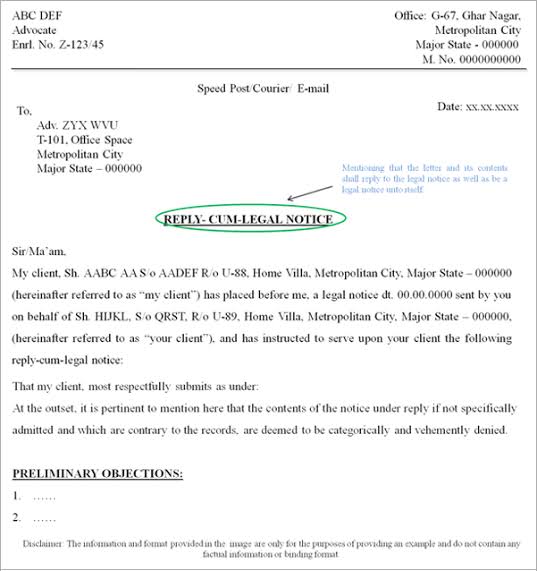
An Exampler Legal Notice
LEGAL NOTICE
Date: _________
To,
[Recipient Name]
[Address]Subject: Legal Notice for Compensation
Sir/Madam,
Due to your actions/negligence on _________, I have suffered financial loss and damages. Despite requests, the matter remains unresolved.
Therefore, I hereby demand compensation of ₹_________ within 15 days from the receipt of this notice.
Failure to comply within the stipulated period will compel me to initiate appropriate legal proceedings at your cost and risk.
This notice is issued without prejudice to my legal rights and remedies.
Sincerely,
[Sender Name]
[Address]
[Signature]
How much do lawyers charge to send a legal notice?
Lawyers in India do not charge a standard fee for legal notices.
It depends on both the lawyer’s seniority and the type of dispute.
Like Average Charge Based on Lawyer:
| Type of Lawyer | Approximate Fee |
|---|---|
| Junior Advocate | ₹1,000 – ₹3,000 |
| Experienced Advocate | ₹3,000 – ₹7,000 |
| Senior Advocate | ₹7,500 – ₹25,000+ |
Charges Based on Dispute Type:
| Type of Notice | Typical Cost |
|---|---|
| Money Recovery | ₹1,500 – ₹5,000 |
| Consumer Complaint | ₹2,000 – ₹7,000 |
| Property Dispute | ₹3,000 – ₹15,000 |
| Defamation Notice | ₹5,000 – ₹20,000 |
| Commercial Dispute | ₹5,000 – ₹25,000+ |
What to do after sending a legal notice?
After sending a legal notice, you might be wondering, “What next?”
I had the exact same thought, but there is no need to worry too much.
Once the legal notice has been sent, you simply need to keep a few things in mind and avoid rushing into anything:
- Keep Proof of Delivery
- Wait for the Response
- Review the Reply
- Consider Settlement Options
- Take Legal Action if Necessary
What happens if a legal notice is not received?
After sending a legal notice, you might wonder what to do if the recipient ignores it.
There are several possible outcomes after sending a legal notice, such as:
- Notice accepted and received
- Notice refused
- Notice marked “Unclaimed”
- Incorrect or incomplete address
- Recipient has moved
Different courses of action will be taken depending on the outcome.
If your notice bounces back with a status like “Refused,” “Unclaimed,” “House Locked,” or “Addressee Not Available,” there is no need to panic.
In such situations, you can approach the court, and this will actually work to your significant advantage.
The court will consider your legal notice to have been successfully served in these instances and may take action against the recipient.
Note: Agr aap Legal Notice ke bounce hone ke baad koi legal action nhi lenge to aapka case weak padh skta hai.
Benefits of Sending a Legal Notice
Sending a legal notice offers you numerous advantages while simultaneously giving the other party an opportunity to resolve the dispute.
It safeguards your legal rights and can often lead to a resolution without the need to go to court.
Beyond these points, there are several other benefits to sending a legal notice, such as:
- Encourages Settlement— Fosters a constructive relationship between the parties and facilitates a resolution to the issue.
- Creates Legal Evidence— Serves as formal evidence demonstrating that you had previously informed the other party about the dispute.
- Saves Time and Money— Protects you from the expenses associated with litigation and saves your time.
- Demonstrates Seriousness— Signals to the other party that you are serious about your rights and are prepared to take strict legal action.
- Improves Chances of Negotiation— Provides both parties an opportunity to negotiate, preventing the dispute from escalating further.
Top 5 FAQs of Drafting a Legal Notice
1. What is the format of a legal notice?
A legal notice includes sender/receiver details, facts, legal grounds, demand, and response deadline.
2. Can I send a legal notice without a lawyer?
Yes, you can send it yourself, but lawyer drafting ensures accuracy and stronger legal impact.
3. How long is a legal notice valid?
There is no fixed validity; response time is usually 15–30 days as mentioned.
4. What are the three types of notice?
Legal notice, public notice, and statutory notice are the three commonly recognized types.
5. What is the limit of a notice?
No strict limit; content must be clear, relevant, and legally justified without unnecessary details.
Conclusion
As a citizen of India—home to one of the world’s largest economies—it is your right to send a legal notice.
Before taking any dispute to court, you should certainly draft a legal notice.
Sending a legal notice is an excellent option if you wish to save both time and money.
And if you have a personal dispute, you can let me know directly; I will do my best to assist you.
“Know your rights, protect them in writing.”
Further Posts: