

Introduction
I have noticed that the UGC is being discussed everywhere these days.
The UGC—or University Grants Commission—is introducing a number of new changes.
In this brief article, I will share the latest UGC updates and new rules with you, and also discuss the impact that will have on students.
These new rules are set to bring about major changes in Indian higher education.
What is University Grants Commission or UGC?
The UGC (University Grants Commission) is the body that regulates higher education in India.
This Commission was established under the UGC Act of 1956, which came into force on November 5, 1956.
India’s education system is one of the largest in the world.
According to AISHE reports, there are over 1,100 universities and 45,000 colleges in India, providing higher education to more than 400,000 students.
Interesting Fact: The UGC was introduced on December 28, 1953, but at that time, it functioned merely as a statutory body.
What are the latest news updates on the UGC Act?
As you may have noticed, minor changes have been taking place in the UGC Act over a long period.
However, major updates regarding the UGC have been introduced in 2026.
Here are some of the most important recent updates released this year:
- Supreme Court Put UGC Equity Regulations 2026 on Hold
- Centre Told Supreme Court the Rules Are Under Reconsideration
- Old 2012 Anti-Discrimination Framework Continues
- Student Protests and Public Debate Continue
- Supreme Court Reiterates UGC Qualification Standards
You may have noticed many students and teachers protesting against the UGC Act.
The Centre stated that some of its rules are still under reconsideration.
In light of this, the Court has stayed the implementation and decided that some changes should be made to the UGC rules.
Here You can learn the Basic or Advance : Legal Notice Drafting
What are the new UGC rules in 2026?

The UGC aims for more than just equity; it has numerous other goals and initiatives.
Consequently, the government frequently amends the University Grants Commission Bill to ensure the regulations are suitable for everyone.
Here are the eight key new UGC rules for 2026.
1. Equal Opportunity Centre (EOC)
Establishing an EOC has been made mandatory for all universities and colleges.
Its establishment offers significant benefits, ensuring support for students in need and providing a mechanism to address complaints regarding discrimination.
The EOC aims to directly protect underprivileged and needy students from discrimination while simultaneously providing them with support.
2. Equity Committee
Under this rule, an Equity Committee will be established in every institution.
This Equity Committee will include representation from various categories, such as:
- SC (Scheduled Caste)
- ST (Scheduled Tribe)
- OBC (Other Backward Class)
- Women
- Persons with disabilities or EWS
To put it simply, ‘equity’ means ensuring equality among all students.
For example, consider Ayan, a student from a backward class, and Shrija, a student from an upper class.
In such a scenario, Ayan would be provided with additional opportunities to bring him on par with Shrija, thereby balancing the playing field and ensuring equality.
The Equity Committee will review complaints and take necessary actions to foster equity among the students.
Get your Caste Certificate in just 10 days – Apply Here for Free
3. Wider Definition of Discrimination
According to the UGC, any form of discrimination will be dealt with very strictly.
Action will be taken if a student faces direct or indirect discrimination based on caste, religion, gender, disability, race, or place of birth.
4. Ombudsperson System
An Ombudsperson System has been established.
This serves as an independent authority that will review cases involving institutions and make appropriate decisions.
For instance, if a student or staff member is dissatisfied with an institution’s decision, they can approach the Ombudsperson Authority.
5. Grievance Reporting Mechanism
The reporting mechanism has also been enhanced under the new UGC rules.
The grievance reporting mechanism provides an easy way for victims to file reports.
This mechanism includes the following facilities:
- Online portals
- Helplines
- Formal complaint systems
6. Mandatory Reporting to UGC
It has been made mandatory for all institutions to report to the UGC.
In their reports, institutions must demonstrate how they are promoting equity within their campuses and how they are resolving complaints.
Mandatory reporting is crucial for enhancing transparency and accountability.
7. Penalties for Non-Compliance
Institutions that fail to comply with or implement UGC rules and regulations will face penalties.
These penalties may include the withholding of grants, the imposition of restrictions, and limitations on academic programmes.
These rules have been introduced to ensure the effective implementation of key regulations.
UGC Bill 2026 PDF Link
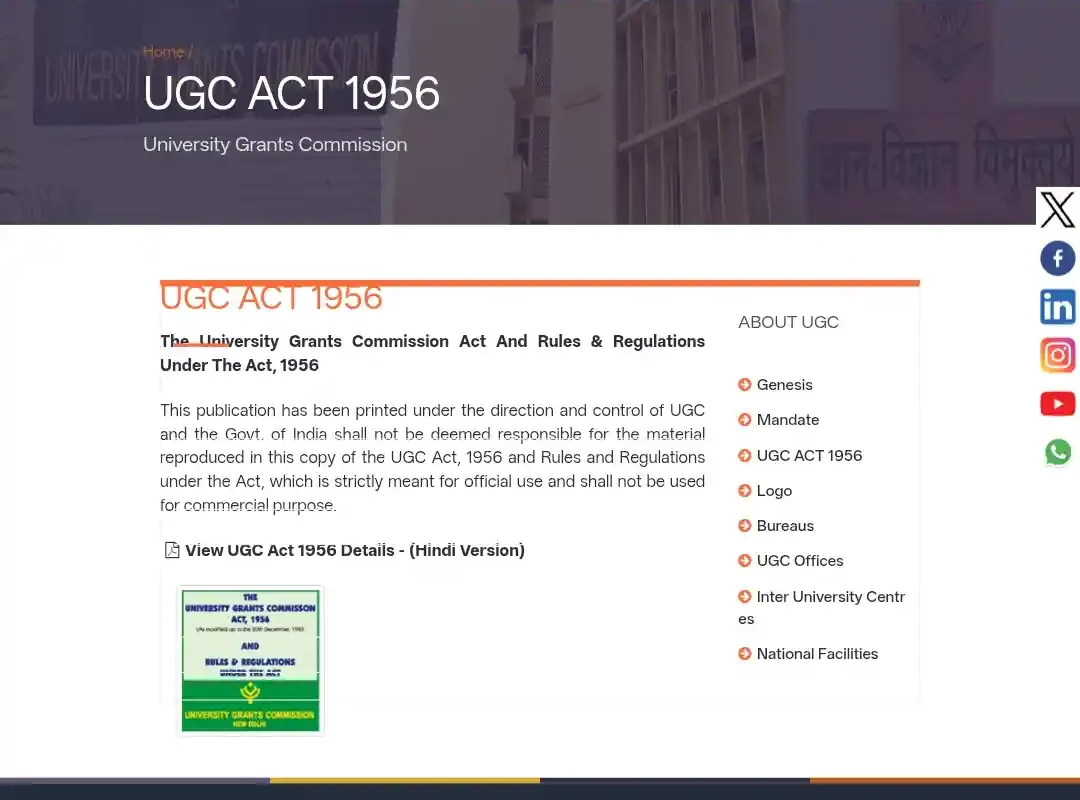
There are frequent updates regarding the UGC in India.
This is not merely a commission; it is an organization established to protect all students from discrimination.
You can find PDFs of the UGC Bill 2026 on various websites, but those are often unofficial.
You can download the official UGC Bill 2026 PDF by clicking this link.
Why Are Students Protesting Against the UGC Bill?
As I have just explained the new UGC rules above, you likely have an understanding of what these regulations entail.
However, while some student groups are protesting against the Commission, higher education institutions are adopting the UGC guidelines.
Under Article 19 of the Constitution—specifically Articles 19(a) and (b)—everyone has the right to peaceful protest.
While individuals possess these constitutional rights, the implementation of the UGC rules is creating a dilemma.
From the students’ perspective, there are several major reasons behind their protests:
- Concerns Regarding Equal Protection: There is a misconception among some students that the UGC will provide protection exclusively to SC, ST, and OBC communities.
- Fear of Misuse of Complaints: Protesters argue that students from backward communities could misuse the complaint mechanism.
- Ambiguity in Definitions: Students are criticizing the definitions of certain terms, arguing that concepts like “discrimination” and “caste-based discrimination” could be interpreted in various ways.
- Concerns About Campus Environment: Some students argue that the introduction of Equity Committees, Equity Squads, and monitoring mechanisms will disrupt the campus environment.
- Demand for Broader Consultation: Students want maximum participation from the student body, teachers, and universities regarding such significant reforms.
Legal Provisions Against Caste Discrimination
Citizens are constitutionally granted certain rights that are essential for everyone.
Here is a list of rights that directly or indirectly address caste discrimination:
Article 14 – Right to Equality
According to Article 14, all individuals are equal before the law and are entitled to equal legal protection.
Treating any person unfairly based on caste is illegal and unconstitutional.
Article 15 – Prohibition of Discrimination
Under this article, it is the role of the judiciary to ensure protection against discrimination.
Discriminating against any person on the grounds of religion, race, caste, sex, or place of birth is illegal.
This right empowers the government to make special provisions for socially and educationally backward classes.
Article 16 – Equality in Public Employment
Article 16 was enacted to ensure equality of opportunity in public employment.
It is essential for everyone to have independent participation in public employment opportunities provided by the government.
This right emphasizes precisely that aspect.
Article 17 – Abolition of Untouchability
This Article is crucial for eradicating the practice of untouchability that has persisted for thousands of years.
Under Article 17, treating anyone in a manner associated with untouchability is a crime.
If you are subjected to such treatment, you can file a complaint against the offender.
Learn how to file an e-FIR: Check Here
Article 46 – Protection of Weaker Sections
This Article was included in the Constitution to protect India’s weaker sections—such as Scheduled Castes and Scheduled Tribes—from exploitation.
Protection of Civil Rights Act, 1955
This Act reinforces the provisions of Article 17 (Abolition of Untouchability).
SC/ST (Prevention of Atrocities) Act, 1989
The SC/ST Act comprises stringent regulations designed to protect Scheduled Castes and Scheduled Tribes from caste-based abuse, discrimination, humiliation, social boycott, etc.
If anyone humiliates individuals belonging to these categories, the aggrieved person can file a police complaint.
What Are the UGC Norms for Teachers?
Establishing high standards and norms for teachers is indicative of an advanced education system.
Therefore, the UGC has taken this into account in its new rules.
Minimum qualifications and standards have been set for appointments and promotions in colleges and universities.
| UGC Norm | Requirement |
|---|---|
| Master’s Degree | Minimum 55% marks |
| NET/SET/SLET | Required for many Assistant Professor posts |
| Ph.D. | Mandatory for Associate Professor and Professor |
| Experience | Required for higher academic positions |
| Research Publications | Needed for recruitment and promotion |
| Selection Process | Merit-based through selection committees |
Which Universities Are Blacklisted by UGC in 2026?
UGC NET has not blacklisted any university but has included them in the list of fake universities.
As of February 2026, the UGC has identified 32 fake universities across India.
Here is the List of No. Of Fake Universities↓
| State/UT | Number of Fake Universities |
|---|---|
| Delhi | 12 |
| Uttar Pradesh | 4 |
| Andhra Pradesh | 2 |
| Karnataka | 2 |
| Kerala | 2 |
| Maharashtra | 2 |
| Puducherry | 2 |
| West Bengal | 2 |
| Haryana | 1 |
| Rajasthan | 1 |
| Jharkhand | 1 |
| Arunachal Pradesh | 1 |
Download here the PDF of all Fake listed Universities in India👇
Examples of Universities Listed by UGC
- Mountain Institute of Management & Technology (Delhi)
- World Peace of United Nations University (Delhi)
- United Nations University (Delhi)
- Vocational University (Delhi)
- Magic & Art University (Haryana)
- Global Human Peace University (Karnataka)
- Gandhi Hindi Vidyapith (Uttar Pradesh)
- Netaji Subhash Chandra Bose University (Open University), Aligarh
- St. John’s University (Kerala)
- Raja Arabic University (Maharashtra)
Important FAQs from UGC
1. What will change after UGC implementation?
Flexible courses, credit transfers, skill-based learning, and multidisciplinary education will transform higher education in India.
2. When UGC Act will implement?
Implementation is phased; many reforms started after National Education Policy 2020 and continue gradually.
3. Why many students protest the UGC act?
Students protest due to confusion, inequality concerns, digital divide, and fear of increased costs.
4. Is UGC a favourable reform?
Generally favourable, as it improves flexibility, skills, and global standards, but concerns still exist.
5. Why High Court stayed UGC Act 2026 orders?
Courts may stay orders due to legal challenges, policy clarity issues, or concerns about fairness.
6. Do UGC rules exploit any human or fundamental rights?
No direct violation, but critics argue some provisions may indirectly affect equality and access.
Conclusion
The UGC emphasizes strict and equitable rules for everyone.
This commission was established to ensure that no student faces discrimination based on caste, religion, gender, or other such factors.
If you are treated unfairly at your college or university, the UGC stands in your support.
“Learning thrives where discrimination ends.”
Further Readings:
- Top 7 New Education Policy Key Rules You should Know
- Easy Steps to File FIR in India Online and Offline